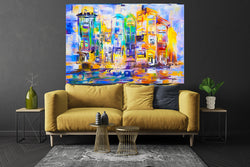


A blank wall can make a finished room feel strangely temporary. The right artwork changes that feeling. It gives a room a point of view, a place for the eye to rest, and a little more of the life of the people who live there. Learning how to start an art collection is less about knowing art-world rules than noticing what moves you and giving those choices a place in your home.
The most memorable collections rarely begin with a grand plan. They begin with one work that feels personal: a textured painting that catches afternoon light, a quiet botanical print, a photograph that recalls a place you love, or a burst of color that makes an otherwise neutral room feel awake.
Start With What You Want to Feel
Before considering artists, editions, or price points, consider the atmosphere you want to create. Art does more than fill a wall. It can bring warmth to a clean-lined living room, softness to an office, or a sense of stillness to a bedroom.
Pay attention to the images and colors you return to without being prompted. You may be drawn to deep blues and layered texture, luminous orchids, expressive wildlife, coastal light, or abstract forms with movement. Those instincts are useful. A collection becomes more cohesive when it is shaped by a genuine visual preference rather than an attempt to match whatever is currently popular.
It also helps to think room by room. A large, energetic work may belong over a sofa or dining room sideboard, where it can hold the space. A smaller print may be more meaningful in a hallway, reading nook, or beside a bed. The goal is not to make every room look the same. It is to let each piece contribute to the feeling of the home.
How to Start an Art Collection at Your Own Pace
A collection does not need to begin with an expensive original, and it does not need to be completed in a season. Set a comfortable annual or per-piece budget, then leave room for the work that truly stays with you. Buying fewer pieces with intention usually creates a stronger collection than buying several items simply because a wall is empty.
Fine-art prints and limited editions are an excellent entry point for new collectors. They offer access to an artist’s imagery in considered formats and can make it possible to experiment with size, subject, and placement. A high-quality giclée print on fine-art paper can bring delicacy and detail to a room, while canvas and metal prints create a more substantial visual presence.
Original work offers something different: the physical evidence of the artist’s hand. With acrylic texture paintings and sculptural canvas works, for example, color shifts across raised surfaces as light changes through the day. That dimensional quality can make an artwork feel especially alive in person. Neither path is more correct. A thoughtful collection can include original paintings, framed works on paper, photography, and limited-edition posters, each chosen for its own character.
If you are deciding between formats, let the room guide you. A work with pronounced texture may be ideal for a wall with open sightlines and natural light. A paper print behind glass can suit a more intimate space. For high-traffic areas, consider a finish and framing approach that fits how the room is used.
Choose Art, Not Just Décor
It is natural to want art that works with your furniture, but matching should not be the only measure. A painting does not have to repeat the exact color of your pillows to belong in the room. Often, a contrast in mood or color is what gives an interior depth.
Look for a relationship instead. A warm landscape may echo the wood tones in a dining room. A blue-green abstract can cool and balance a sunlit space. A floral print with a soft, dreamlike background might bring calm to a room with more tailored furnishings. Let the artwork be a focal point, not an afterthought selected only to fill a color gap.
When viewing a piece online, imagine living with it beyond the first impression. Would you enjoy seeing it every morning? Does it offer something new when you look closely? Is there a detail, texture, or color relationship that holds your attention? The work does not need to tell a complicated story. It simply needs to continue feeling like yours.
Learn a Few Practical Details Before You Buy
You do not need formal art training to buy with confidence, but a few questions can help you choose well. For original work, ask about the medium, surface, dimensions, and whether the piece is ready to hang. For prints, understand the substrate, edition information when applicable, and whether framing is included.
Material changes the experience of an image. Fine-art paper often has a refined, tactile quality and works beautifully with traditional or modern framing. Canvas can feel painterly and warm, especially at larger sizes. Metal prints tend to offer crisp detail and a clean contemporary finish. There is no universal best choice. The right substrate depends on the artwork, your interior, and the mood you want to create.
Scale deserves equal attention. One of the most common mistakes is choosing artwork that is too small for the wall. Before purchasing, use painter’s tape or kraft paper to outline the artwork’s dimensions where it will hang. Step back from the doorway and from the seating area. A piece that seems large on a screen may look modest over a wide sofa, while a small original can have wonderful presence when given a wall of its own.
If you are building a gallery wall, begin with a single anchor piece and add around it gradually. Keeping one element consistent, such as frame color, a recurring subject, or a shared color family, can create harmony without making the arrangement feel overly planned.
Buy From Artists and Sources You Trust
Collecting becomes more meaningful when you know something about the person and process behind the work. Buying directly from a working artist offers a closer connection to the artwork, along with clarity about materials, care, and the story that shaped the piece.
Confidence also comes from the practical side of the purchase. Look for clear photographs, accurate dimensions, thoughtful descriptions, professional packaging, and straightforward communication. Artwork should arrive ready to become part of your space, not as a source of uncertainty.
This is especially helpful with original works, where subtle details can be difficult to capture online. Texture, reflective passages, and layered color often reveal more in changing light than they can in a single photograph. A reliable artist or gallery will be open about those qualities and help you understand what to expect.
Let Your Collection Have a Point of View
A collection can be unified without being uniform. You might collect works connected by nature, generous color, expressive surfaces, or moments of quiet observation. Over time, those threads become visible. They tell a story about what you notice and what you want your home to hold.
Avoid the pressure to make every new piece coordinate perfectly with the last. Some of the most compelling rooms pair a vivid contemporary painting with a restrained photograph, or a sculptural canvas with a small botanical print. The conversation between different works can be more interesting than a strict match.
At the same time, give yourself permission to wait. If you like a piece but cannot picture where it belongs, save the idea and return to it later. A little patience protects your budget and makes the eventual choice feel more certain.
Live With the Art You Choose
Once a piece arrives, give it room to breathe. Hang it at a comfortable viewing height, generally with the center near eye level, and consider how nearby lamps and windows affect it. Texture and color can shift beautifully from morning to evening, particularly in work made with layered paint or reflective surfaces.
Caring for art is usually simple. Keep original paintings and paper works away from persistent direct sun, high humidity, and dramatic temperature swings. Dust gently with a soft, dry cloth when appropriate, and follow the artist’s care guidance for the specific material. These small habits help preserve the color and surface you fell in love with.
Your first purchase does not need to define every choice that follows. Let it be the beginning of a home that becomes more personal over time, one meaningful work at a time.