

Table of Contents
- How to Verify Art Authenticity Online
- Saatchi Art vs UGallery Comparison: What Collectors Should Know
- Online Art Gallery Return Policies: What to Look For
- Secure Payment and Escrow Services for Art Acquisitions
- Shipping, Insurance, and Art Handling Logistics
- Red Flags and Legal Recourse for Counterfeit Art
- Conclusion: Building Confidence in Online Art Purchases
- Frequently Asked Questions
Last Updated: September 11, 2026
How to Verify Art Authenticity Online
Buying art online is safe when you verify authenticity before payment, not after delivery. Start with the artist's identity, the work's provenance, and independent documentation of its condition. At Just Art by John, every original painting, sculpture, and Giclèe print is personally created by John Cranshaw.
Request High-Resolution Images and Condition Reports
High-resolution images and a written condition report are your first line of defense. Ask for detail shots of the signature, frame edges, back of the canvas, and any wear.
A condition report is a written description of a work's physical state, including flaws, restoration, and framing. Request it in writing so you have a record if the piece arrives differently than described.
Watch for these gaps:
- Photos that are low-resolution, watermarked, or reused across multiple listings
- No image of the signature or edition number
- Refusal to provide additional angles or measurements
Check Artist Identity and Provenance
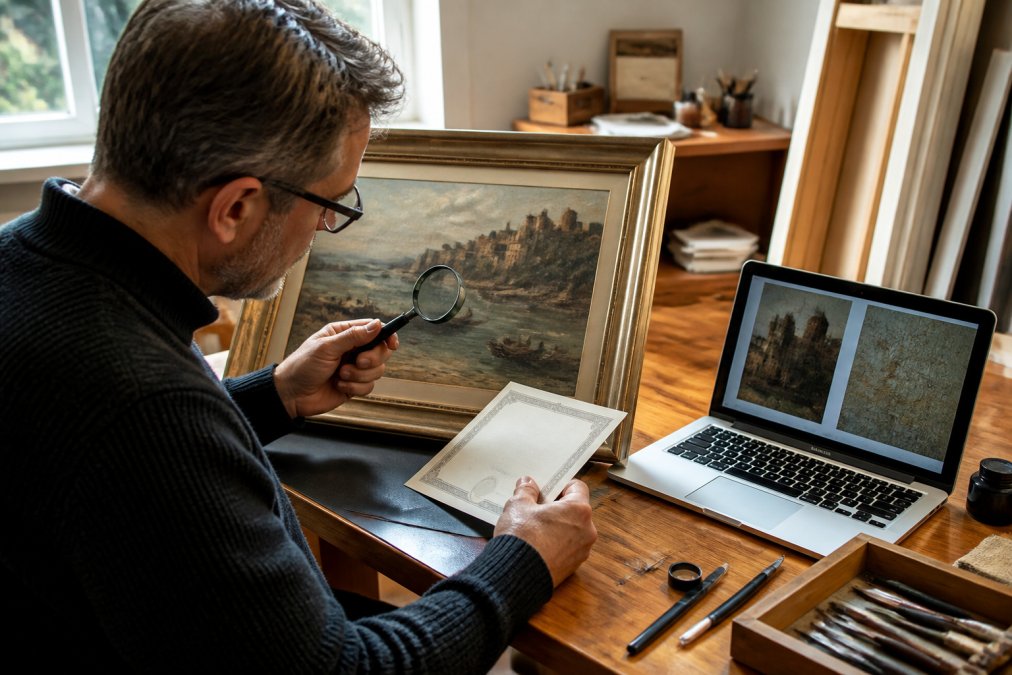
Provenance is the documented history of a work's ownership, from the artist's studio to the current seller. It matters more than any single photograph.
Confirm the artist exists as a real, traceable entity with a consistent body of work and a clear relationship to the pieces sold. For works by John Cranshaw, the art is personally created by the artist.
Ask for the following:
- A certificate of authenticity (COA) that names the artist, the title, the medium, the dimensions, and the date
- Any exhibition history, catalog references, or prior sales records
- A signed statement of provenance if the work has changed hands before
A COA is only as strong as the seller behind it. A certificate from an unknown third party carries less weight than one issued directly by the artist or a recognized gallery.
Saatchi Art vs UGallery Comparison: What Collectors Should Know
Most guides reduce this decision to brand preference. The real question is structural: which marketplace model gives you a stronger paper trail, and which leaves you holding the risk if the work is misrepresented? That comes down to listing disclosure, payment custody, and dispute resolution.
A digital marketplace connects artists or galleries with buyers, typically taking a commission per sale. Its reputation becomes part of your due diligence because it mediates disputes, payments, and returns, and two marketplaces can behave completely differently when a transaction goes wrong.
The Three Structural Questions That Actually Matter
1. Who holds the money, and when is it released?
Some platforms release funds to the seller on shipment; others hold funds until the buyer confirms delivery. The second model is functionally escrow and is the single biggest structural protection a marketplace can offer. Ask directly: does the seller get paid before I confirm receipt? If yes, your only recovery path is a chargeback through your card issuer.
2. Who decides a condition dispute, and against what standard?
A return policy is meaningless without a named decision-maker. Some platforms adjudicate disputes internally; others push buyer and seller to resolve it themselves. Before you buy, find the clause naming who inspects the returned work and who bears the cost if the two sides disagree about pre-existing damage.
3. What does the listing actually disclose?
Edition transparency is where marketplaces diverge most. An open-edition print and a signed, numbered edition of 25 can look identical in a thumbnail. The listing should state, in the platform's own fields, whether the work is an original, a limited edition (with run size and the number you are buying), or an open-edition reproduction. No structured field for edition size is itself information.
How the Two Models Typically Compare
| Factor | Open-submission marketplace | Juried, gallery-style marketplace |
|---|---|---|
| Curation model | Broad artist submissions with review | Tighter, gallery-style selection |
| Edition transparency | Varies by artist; check the listing fields | Generally documented per work |
| Original vs. print mix | Broad, includes many prints and reproductions | Leans toward originals |
| Payment custody | Often releases funds on shipment | Often holds funds until delivery confirmation |
| Dispute resolution | Platform-mediated, standard varies | Platform-mediated, standard varies |
| Best for | Browsing a wide selection | Collectors wanting tighter curation |
Neither model is inherently safer. What matters is whether the listing documents the edition, condition, and artist's identity clearly, and whether the platform's payment and dispute mechanics give you a recovery path.
What to Confirm Before You Check Out
- Does the seller receive funds before you confirm delivery, or after?
- Is there a written condition standard the platform applies to disputes?
- Does the listing use structured fields for edition size, medium, and dimensions, or only free text?
- What is the platform's stated timeline for responding to a dispute, and does it pause the seller's payout during that window?
If you cannot get clear answers to those four questions, treat the transaction as an unmediated private sale and apply the payment and documentation practices in the sections below accordingly.
Online Art Gallery Return Policies: What to Look For
A return policy is only useful if it covers what actually happens: color mismatch, undisclosed damage, or a piece that does not work in your space. But the policy is only half the equation, the other half is what you do in the first hours after the box arrives, when most disputes are won or lost.
The Clauses That Decide Whether You Can Actually Return
The strongest policies offer a defined inspection window, cover condition disputes, and do not require you to prove a subjective dislike. The weakest bury restocking fees and exclude "custom" or "original" works.
Check these clauses:
- Inspection window: How many days do you have to report a problem? Count from the delivery date, not the order date.
- Condition disputes: Who decides whether damage was pre-existing, the seller, the platform, or a neutral third party?
- Return shipping: Who pays, and is the artwork insured in transit back? An uninsured return shipment that is damaged in transit can leave you liable for the full value.
- Exclusions: Are originals or commissions carved out of the policy? Many policies cover prints but exclude one-of-a-kind works entirely.
- Restocking fees: A percentage fee on a high-value original can exceed the cost of a professional condition inspection.
- Refund method and timing: Does the refund go back to your original payment method, and within how many days?
Post-Purchase Verification: The Step Almost No Guide Covers
Before you open the box: photograph the sealed packaging from multiple angles, including the shipping label and any dents or punctures. Timestamped photos are the fastest way to win a condition dispute.
During unboxing: open the package on video in one continuous take. This is the single most useful evidence in a damage or misrepresentation claim.
After unboxing, verify against the listing:
- Signature and edition number. Compare the signature to the high-resolution images the seller provided before purchase. For a limited edition, confirm the number you received matches the number you bought.
- Dimensions. Measure the work and the frame. A piece listed at one size and delivered at another is a misrepresentation, not a subjective dislike.
- Medium. Confirm the work is what the listing said, an original, a limited-edition print, or an open-edition reproduction. A print sold as an original is the most common form of online art misrepresentation.
- Condition report match. Compare the work against the written condition report. Any flaw not disclosed in that report is a condition dispute, not normal wear.
- Certificate of authenticity. Confirm the COA names the artist, title, medium, dimensions, and date, and that it matches the work in hand.
If the Work Does Not Match: The Dispute Sequence
Act in this order, and act fast, because inspection windows are short.
- Preserve everything. Keep the packaging, the COA, all listing screenshots, and every message. Do not discard the box.
- Notify the seller in writing through the platform, stating specifically what does not match the listing or condition report.
- Open a platform dispute if the seller does not resolve it within the platform's stated response window. Ask the platform to pause the seller's payout if funds have not yet been released.
- If the platform does not resolve it, escalate to your payment provider. Credit card chargebacks generally must be filed within the issuer's dispute window, which is often shorter than buyers assume, check your cardholder agreement for the exact deadline.
- For suspected fraud or counterfeit goods, report the transaction to the platform, your payment provider, and the FBI Internet Crime Complaint Center. The Federal Trade Commission handles deceptive sales practices, and the U.S. Copyright Office publishes guidance on infringement claims.
Legal recourse is strongest with documentation. A clear paper trail, listing, condition report, unboxing video, written dispute, turns a dispute into a case.
Secure Payment and Escrow Services for Art Acquisitions
Escrow is a payment arrangement where a neutral third party holds funds until both sides meet the agreed conditions, protecting you from paying for a work that never ships or arrives materially different from its description.
Transaction security comes down to how the money moves. Credit cards and established processors offer chargeback rights if the seller fails to deliver; direct wire transfers and peer-to-peer apps generally do not.
Prioritize payment methods in this order:
- Credit card through a reputable processor, for chargeback protection
- Platform escrow, where the marketplace holds funds until delivery is confirmed
- Bank transfer only with a signed contract and verified seller identity
For higher-value pieces, escrow services designed for art logistics are worth the coordination. They confirm delivery and condition before releasing funds, which turns a tense transaction into a routine one.
Shipping, Insurance, and Art Handling Logistics
Art handling is where many otherwise safe purchases go wrong. Canvas tears, cracked frames, and water damage happen in transit, and the difference between a resolved claim and a total loss is whether shipping insurance was in place before the box left the studio.
Shipping insurance covers the declared value against loss or damage in transit. Confirm the declared value matches what you paid, under-insured shipments are the most common cause of unrecoverable losses.
Request the following from any seller:
- Professional packing with corner protection and moisture barriers
- A tracking number and signature-on-delivery requirement
- Insurance at full declared value, with the policy details shared before shipment
- Clear instructions for documenting damage at the moment of delivery
If a piece arrives damaged, do not discard the packaging. Photograph everything, file the claim immediately, and notify the seller in writing within the inspection window.
Red Flags and Legal Recourse for Counterfeit Art
A counterfeit is a work presented as something it is not, whether a forged signature, a misrepresented edition, or a print sold as an original. Recognizing the warning signs early is cheaper than pursuing a remedy later.
Common red flags include:
- Prices far below the market for comparable work
- A COA from a source you cannot verify
- Pressure to pay outside the platform's checkout
- Inconsistent provenance stories or missing documentation
- Seller reluctance to provide a real name, address, or business record
If you suspect fraud, act quickly. Preserve all communications, listing screenshots, and payment records. Report the transaction to the platform, your payment provider, and, where appropriate, your state attorney general's office or the FBI Internet Crime Complaint Center. For counterfeit goods, the U.S. Copyright Office publishes guidance on infringement claims, and the Federal Trade Commission handles deceptive sales practices.
Conclusion: Building Confidence in Online Art Purchases
Buying art online is safe when you treat verification, payment security, and logistics as one connected process. Collectors who avoid trouble ask for provenance, pay through protected channels, and insure the shipment before it moves.
Every piece at Just Art by John is personally created by John Cranshaw, and the collection spans original works, fine art Giclèe prints, and sculpture. View cart to explore the collection.
Frequently Asked Questions
Is it safe to buy art online?
Buying art online is safe when you take proper precautions. Reputable online galleries provide high-resolution images, condition reports, certificates of authenticity, and clear return policies. Use secure payment methods like credit cards or escrow services, and research the seller's reputation. Many collectors successfully acquire original artwork and limited edition prints from established online marketplaces and artist websites.
How can I verify the authenticity of art purchased online?
To verify art authenticity online, request a certificate of authenticity (COA) that includes the artist's name, title, medium, dimensions, and edition number if applicable. Ask for provenance documentation showing the artwork's history of ownership. Compare high-resolution images with the artist's known style. For higher-value pieces, hire a qualified art appraiser. Check that the seller's description matches the COA and that edition transparency is clear for limited edition prints.
What should I look for in an online art gallery's return policy?
A strong online art gallery return policy should offer at least 7-14 days to return the artwork after delivery, clearly state who pays return shipping, and explain the condition requirements for a full refund. Look for policies that cover damage during transit and provide a straightforward process for initiating returns. Some galleries offer buyer protection guarantees. Always read the fine print before purchasing, especially for original artwork or high-value pieces.
How do I know if an online art seller is legitimate?
Legitimate online art sellers provide clear contact information, a physical address or gallery location, and a professional website with detailed artwork descriptions. They offer secure payment options, transparent return policies, and verifiable artist backgrounds. Check for customer reviews, social media presence, and whether the seller is registered as a business. Be cautious of prices that seem too low, pressure to pay outside the platform, and sellers who avoid providing provenance or COA documentation.