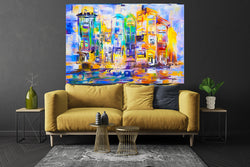


A room can be beautifully furnished and still feel unfinished. Often, what is missing is not another pillow or a larger rug, but a work of art with presence - something made by a person, carrying a particular gesture, color story, and point of view. If you are wondering where to buy original art online, the best answer is not simply a marketplace or a gallery name. It is a source that helps you feel the work, understand its making, and buy with clarity.
Buying art online asks for a little imagination. You cannot stand in front of the canvas and watch the texture change as the light moves across it. But you can still make a deeply confident choice when the artist or gallery gives you an honest view of the work, clear details, and enough context to picture it in your own space.
Where to Buy Original Art Online: Start With the Source
The most rewarding place to buy original art online is often directly from a working artist or from a gallery that represents artists thoughtfully. A direct artist relationship gives a purchase a more personal dimension. You are not choosing generic wall décor from a warehouse. You are bringing home a one-of-one work shaped by a real studio practice.
Artist websites are especially strong when you are drawn to a recognizable visual language: rich acrylic texture, quiet botanical forms, expressive abstraction, wildlife imagery, or sculptural surfaces that bring dimension to a wall. You can see how individual works relate to a larger body of work, which helps you understand whether the piece is a passing experiment or part of an artist's enduring vision.
A reputable online gallery can be an excellent choice, too, particularly if you want to compare several artists or styles in one place. Look for galleries that identify the artist clearly, explain the medium and dimensions, and provide substantial images of the actual piece. If a listing feels vague about who made the artwork, what it is made from, or whether it is truly unique, pause before purchasing.
Large art marketplaces offer range and discovery, but they require more careful filtering. They can be useful when you already know the style, size, or budget you have in mind. The trade-off is that listings may vary widely in photography, accuracy, fulfillment standards, and artist information. A lower price can be appealing, but it should not come at the cost of knowing exactly what will arrive at your door.
Learn the Difference Between Original Art and Reproductions
An original is a unique work made by the artist's hand. It may be a painting, drawing, mixed-media piece, photograph in a stated edition, or sculptural canvas work. No second copy exists in precisely the same form. Variations in texture, brushwork, and surface are part of its character.
A print or reproduction is created from an original image and produced in more than one copy. A fine-art giclée print can be beautiful, carefully made, and an excellent way to live with an artist's work at a more accessible price. It is simply not the same category as a one-of-one original.
Neither choice is automatically better. It depends on what matters most to you. If you want visible texture, a singular object, and the feeling that the work was made only once, choose an original. If you are furnishing several rooms, shopping for a gift, or looking for a larger scale within a defined budget, a high-quality print on canvas, metal, or fine-art paper may be the more practical fit.
The key is clear labeling. A trustworthy seller will distinguish original paintings from open-edition prints, limited editions, artist proofs, and posters. They should also state whether a work is signed, numbered, framed, or ready to hang.
Read the Details That Tell You How a Piece Will Live
When art is viewed on a screen, the product details do a great deal of work. Start with dimensions, then go beyond them. A 24-by-36-inch painting may sound substantial, but its effect depends on the wall, ceiling height, furniture beneath it, and the amount of open space around it.
Before buying, use painter's tape to outline the dimensions on your wall. Stand back, then view the shape from the place where you usually enter the room. This small exercise often settles questions of scale more quickly than any digital room preview.
Material information matters as well. For an original, look for the support and medium: acrylic on canvas, oil on panel, watercolor on paper, or mixed media with raised elements. If texture is central to the work, close-up images are essential. They reveal whether the surface is gently layered or boldly sculptural, and they help you imagine how daylight or a nearby lamp will bring it to life.
Also check whether the work is framed, gallery-wrapped, or requires framing after arrival. A gallery-wrapped canvas can often be hung as it is, offering a clean contemporary look. Works on paper may need a frame and mat, which adds time and cost but can create a more tailored finish.
Let the Room Guide the Choice, Not Control It
Art does not need to match every color in a room. In fact, a piece that introduces an unexpected blue, a warm field of coral, or a deep botanical green can give a neutral space its pulse. Think less about matching and more about conversation. What colors already live in the room? What mood do you want to deepen or change?
For a bedroom, many people gravitate toward softer movement, natural forms, and colors that feel restful at the end of the day. In a dining room or entry, a more energetic painting can create an immediate sense of welcome. An office may benefit from work that feels focused and expansive rather than overly busy. The right choice is personal, but it should support the way you want to feel in the space.
Do not overlook texture when selecting art for interiors. A textured original can bring warmth to rooms with smooth walls, polished tables, glass, or clean-lined furniture. It adds visual depth without requiring more objects on a shelf. This is one reason sculptural canvas work can become such a meaningful focal point: it changes subtly through the day as shadows and light shift across the surface.
Ask the Questions That Build Purchase Confidence
Good art sellers welcome practical questions. Before placing an order, confirm that the listed images show the actual original, not only a representative image. Ask about the signature, the date, and the certificate of authenticity if one is provided. For a high-value purchase, it is reasonable to ask for an additional image or a close-up of the surface.
Shipping deserves equal attention. Original art should be packed with materials appropriate to its medium and size, with protection for corners, surfaces, and frames. Review the seller's shipping timeline, return policy, and process for resolving damage in transit. Original works can have different return terms than prints, especially when made to order or shipped internationally, so read those details before buying rather than after the box arrives.
This is also where buying directly from an artist can feel especially reassuring. At Just Art by John, for example, the experience is built around direct access to the artist alongside clear material details and secure packaging. That kind of straightforward communication matters when you are choosing a work intended to stay with you for years.
Buy What You Want to Keep Looking At
Trends can be useful for inspiration, but they are a poor substitute for connection. A painting does not need to coordinate perfectly with every future sofa, and it does not need approval from everyone who visits. It should make you look twice. It should offer something new in morning light, in the quiet after dinner, or during an ordinary pause in the day.
Set a budget that feels comfortable, including framing and shipping if those are separate. Then give yourself permission to choose with both care and instinct. The most lasting artwork is rarely the piece that seemed safest online. It is the one whose color, texture, or stillness continues to feel alive once it becomes part of your home.