


Table of Contents
- Plan Your Layout Before You Touch a Hammer
- How to Match Art with Wall Color for a Cohesive Look
- Hang Art at Eye Level and Create a Focal Point
- Use the Best Lighting for Original Art Without Causing Damage
- How to Hang Art Without Damaging Walls: Anchors and Hardware
- Protect Your Investment: Conservation and Environmental Control
- Arrange a Gallery Wall with Original Paintings
- Conclusion: Display Original Paintings with Confidence
- Frequently Asked Questions
Last Updated: September 9, 2026
Displaying original paintings at home is about more than finding an empty wall and driving a nail. The difference between a room that feels curated and one that feels cluttered comes down to planning, placement, and protection. The most common mistake is hanging art before considering how light, wall color, and hardware interact with the piece.
This guide covers the full process of learning how to display original paintings at home, from planning your layout to protecting your investment with proper conservation. You will learn how to match art with wall color, position pieces at eye level, choose safe lighting, and hang art without damaging your walls. These strategies work whether you are hanging a single statement piece like an original painting from our collection or arranging a full gallery wall.
Plan Your Layout Before You Touch a Hammer
The most common mistake is hanging art before considering the room's traffic flow and existing furniture. Start by measuring your wall space and mapping the dimensions of each painting you plan to display. Use painter's tape on the wall to outline the exact footprint of each frame, which lets you test arrangements without committing to holes.
Consider the scale of your paintings relative to your furniture. A large canvas above a sofa should span roughly two-thirds of the sofa's width to create visual balance. For smaller works, group them to read as a single unit. Digital visualization tools can help you preview layouts before you pick up a drill, and many are free to use.
How to Match Art with Wall Color for a Cohesive Look
Matching art to wall color is a matter of contrast, not coordination. A painting with deep tones, such as Dark Flowers on a Wall, will recede against a dark wall but pop dramatically against a light neutral. Conversely, a bright piece becomes the anchor of a room when placed on a deep, moody wall.

A practical approach is to pull a secondary color from the painting and echo it in your decor. If your original artwork features soft whites and weathered textures, like White Flowers on a Fence, consider warm greige walls that complement rather than compete. The goal is a cohesive look where the painting and the room enhance each other without matching exactly.

Hang Art at Eye Level and Create a Focal Point
The center of your painting should sit at eye level, generally 57 to 60 inches from the floor. This standard, used by galleries and museums, places the work in your natural line of sight. When hanging above furniture, the gap between the frame and the piece below should be 6 to 8 inches to keep the grouping visually connected.
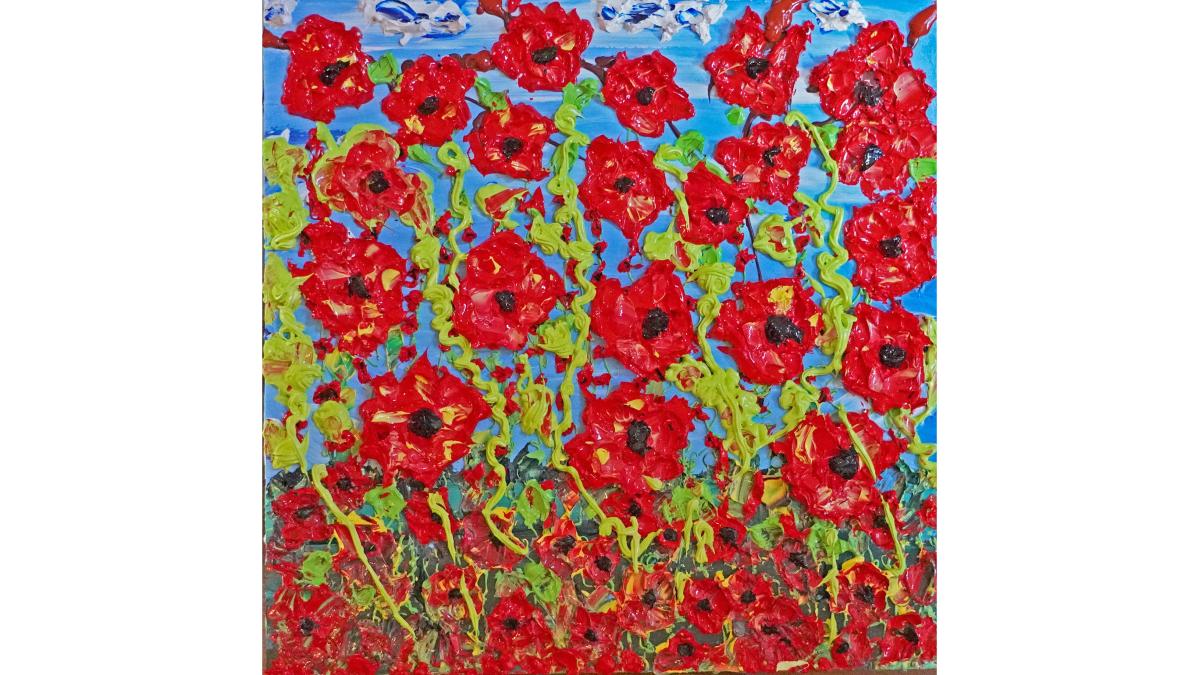
For a single statement piece, position it so it becomes the room's focal point. An original like Red Flowers in a Meadow draws the eye with its vibrant crimson against fresh green, making it ideal for anchoring a seating area. When hanging multiple works, treat the group as one unit and center the entire arrangement at eye level, not each individual frame.
Use the Best Lighting for Original Art Without Causing Damage
Most lighting advice stops at "avoid direct sun," but protecting an original painting requires understanding why light damages it and how to measure and control the risk. Light damage is cumulative and irreversible: ultraviolet (UV) radiation breaks down pigment binders, while visible light, especially blue wavelengths, causes photochemical fading. Infrared (heat) radiation dries out canvas and paint layers, leading to embrittlement and cracking.
Set a Target Light Level
Museum professionals commonly aim for 50 lux (approximately 5 foot-candles) for works on paper and up to 150-200 lux for oil and acrylic paintings on canvas. Most homes have no way to measure lux without a meter, but a simple rule applies: if the light level is comfortable for reading a book, it is likely safe for a painting. If the light feels bright enough to cause glare on a screen, it is too high for daily exposure.
Filter Natural Light at the Window, Not the Painting
The most effective protection is to stop UV before it reaches the canvas. Install UV-filtering window film on any window that casts direct or strong indirect light onto the painting. This film blocks 98-99% of UV radiation while remaining optically clear. For south- and west-facing windows, pair the film with sheer curtains or blinds to diffuse the remaining visible light. Do not rely on a UV-filtering glass in the frame alone, it protects the surface but not the back of the canvas, which can still be damaged by heat buildup.
Choose Fixtures That Emit No UV and Low Heat
For artificial lighting, use LED picture lights or track heads with a color temperature between 2700K and 3000K (warm white). LEDs emit virtually no UV and very little infrared heat compared to halogen bulbs. Position the fixture at a 30-degree angle from the painting's surface to minimize specular glare. If you use a picture light mounted on the frame, ensure the fixture has a diffuser or frosted lens so the beam spreads evenly rather than creating a hot spot in the center.
Watch for the Three Hidden Culprits
- Halogen track lighting: Emits significant UV and heat. Replace with LED retrofit bulbs if your track system cannot be changed.
- South-facing windows without treatment: Even indirect light from a south window can deliver damaging UV for several hours a day. Apply window film or mount a UV-filtering acrylic sheet inside the frame.
- Picture lights with incandescent bulbs: These produce heat that rises and can dry out the upper portion of the canvas over years. Switch to an LED picture light.
For a deeper reference on light damage thresholds, consult the Smithsonian's Museum Conservation Institute guidelines on lighting, which publishes recommended illumination levels for different media. The key takeaway is that consistent, low-level, UV-filtered light is always safer than bright, intermittent light, even if the bright light is only on for a few hours a day.
How to Hang Art Without Damaging Walls: Anchors and Hardware
Hanging hardware must match the weight of your framed painting, not the size of the frame. A small but heavy canvas in a thick wood frame can weigh far more than a large, lightweight piece. Weigh your painting before selecting hardware, and always account for the frame, mat, glazing, and hanging wire, not just the canvas.
Know Your Wall Type Before You Drill
Drywall (1/2-inch or 5/8-inch): For paintings up to 5 pounds, a picture hook with an 18-gauge nail driven into a stud is sufficient. For 5 to 20 pounds, use a self-drilling drywall anchor rated for the weight. For 20 to 50 pounds, use a toggle bolt or molly bolt, these expand behind the wallboard and distribute the load. Never hang a painting over 50 pounds on drywall alone; locate a stud and use a lag screw or heavy-duty picture hook rated for the weight.
Plaster (common in pre-1950s homes): Plaster is hard and brittle. Always drill a pilot hole with a masonry bit before inserting any anchor. Use a plastic or fiber anchor designed for plaster, or a molly bolt that expands behind the lath. Do not hammer nails directly into plaster, they will crack the surface and may not hold. For paintings over 30 pounds on plaster, screw into a wooden stud or lath behind the plaster if you can locate it.
Brick or concrete: Use a masonry anchor (sleeve anchor or wedge anchor) with a masonry bit. Drill a pilot hole, insert the anchor, and tighten the screw. Do not use standard drywall anchors in masonry, they will strip out.
Use Two Hanging Points, Not One
A single nail or hook in the center of the frame allows the painting to shift and tilt over time. Install two D-rings or screw-eyes on the back of the frame, one on each side, and run a braided steel picture wire between them. Hang the wire over two separate hooks spaced evenly apart. This distributes the weight and keeps the painting level. For frames over 40 pounds, use two wall hooks positioned at the same height, each rated for at least half the total weight.
The Two-Person Rule for Heavy Originals
For paintings over 30 pounds, never attempt to hang alone. One person holds the painting against the wall at the marked position while the other marks the hook locations with a pencil. Then set the painting aside, install the hardware, and have both people lift the painting into place. This prevents the frame from slipping and damaging the wall or the canvas.
Check the Frame's Structural Integrity
Before hanging, inspect the back of the frame for loose corner joints or a missing crossbar. A frame that is not rigid will flex under its own weight, stressing the canvas and causing the paint layer to crack. If the frame has a loose corner, reinforce it with corner brackets or consult a professional framer. For large canvases (over 36 inches on any side), the frame should have a center crossbar or a strainer to prevent bowing.
When to Call a Professional
If your painting weighs over 75 pounds, is an heirloom, or is on a plaster wall you are unsure about, hire a professional art installer. The cost of a mistake, a dropped painting or a cracked wall, far exceeds the installation fee. For reference on professional standards, consult hanging guidelines from the American Alliance of Museums, which recommends hardware rated for at least twice the weight of the object to account for dynamic loads.
Protect Your Investment: Conservation and Environmental Control
Original paintings are sensitive to their environment, and conservation begins before the piece ever reaches your wall. Maintain indoor humidity between 40 and 60 percent to prevent canvas from becoming brittle or slack. Sudden temperature swings cause the canvas to expand and contract, which can lead to cracking in the paint layer over time.
Keep paintings away from heating vents, fireplaces, and exterior walls where condensation can form. The back of the canvas should have space to breathe, so avoid pressing the frame flush against the wall if possible. Dust paintings gently with a soft, dry brush rather than a damp cloth, which can push moisture into the pigment. For deep cleaning or any signs of flaking paint, consult a professional conservator rather than attempting repairs yourself.
Arrange a Gallery Wall with Original Paintings
A gallery wall is a composition of multiple works arranged to feel intentional. The two primary approaches are symmetrical and asymmetrical arrangements. Symmetrical layouts use identical spacing and matching frame sizes, creating a formal, balanced feel. Asymmetrical arrangements, which are more common in modern interiors, balance different sizes and orientations around a central focal point without mirroring each side.
For a cohesive gallery wall, establish consistent spacing. A gap of 2 to 3 inches between frames keeps the group tight and unified. Mixing media is encouraged, but anchor the arrangement with a common element, such as a shared color palette or similar frame finish. Picture ledges offer a flexible alternative to hanging: you can prop paintings and swap them easily without committing to new holes.
To plan your layout, lay the paintings on the floor first and experiment with arrangements. Once you settle on a composition, measure and mark the wall before hanging. A common mistake is starting at the edges and working inward, which often leaves the center misaligned. Start from the center piece and work outward to maintain the composition's integrity.
Conclusion: Display Original Paintings with Confidence
Displaying original paintings at home requires attention to placement, lighting, and conservation, but the result is a space that reflects your personal taste. Whether you are hanging a single statement piece or building a gallery wall, the principles of eye-level placement, balanced scale, and protective lighting apply to every original work.
At Just Art by John, we help collectors choose pieces that suit their spaces, from original paintings to fine art Giclée prints. Our collection includes works designed to anchor a room, such as the serene Sunday Morning painting, which captures a quiet, contemplative mood ideal for a reading nook or bedroom. For dramatic contrast that holds attention, conservation resources from the Getty Conservation Institute confirm that proper environmental control is the single most important factor in preserving your art's longevity.

Start with a single piece you love, and let the room respond to it. View our current originals and find the painting that belongs on your wall.
Frequently Asked Questions
What is the ideal height to hang original paintings?
Center the artwork at 57 inches from the floor, which is average eye level. For a painting hung above a sofa or console, keep the bottom edge 6 to 8 inches above the furniture. This creates a visual connection between the art and the piece below it. When in doubt, step back and view the painting from standing height to confirm the composition feels balanced.
How do I protect original paintings from sunlight and humidity?
Avoid direct sunlight, which causes fading and pigment breakdown. Use UV-protective glass if framing is an option, and install sheer curtains or blinds on nearby windows. Keep original paintings in rooms with stable humidity between 40 and 60 percent. Avoid hanging art in bathrooms or above heat sources, where moisture and temperature shifts can warp the canvas over time.
What is the best lighting for original art in a home?
Use picture lights or adjustable track lighting with LED bulbs. LEDs emit minimal heat and no UV radiation, making them the safest choice for original paintings. Position the light at a 30-degree angle from the wall to reduce glare and create even illumination. Avoid halogen bulbs, which generate significant heat and can accelerate paint and varnish degradation.
Can I hang original canvas paintings without a frame?
Yes, unframed canvas paintings with painted edges can be hung directly on the wall using a French cleat or a heavy-duty picture hanger. For a clean, modern look, skip the frame and let the canvas extend to the edge. Ensure the hanging hardware is rated for the canvas weight, and check the wire or cleat periodically for signs of wear.