

Last Updated: November 1, 2026
Quick Summary
To learn how to verify provenance for digital art purchases, gather every ownership record from the seller, confirm the artist's identity in writing, and check NFT contract addresses and transfer history on a block explorer. Then compare the delivered file's hash and metadata against the artist's published records, and get copyright and licensing rights stated in writing.
- Provenance proves a chain of records, not the value or merit of the artwork.
- A certificate of authenticity is one data point, not independent proof.
- Match the NFT contract address character-for-character against the artist's published address.
- A matching file hash confirms a byte-identical copy of the file the artist hashed.
- Copyright stays with the creator unless a written agreement transfers it.
Table of Contents
- Step 1: Understand What Digital Art Provenance Actually Proves
- Step 2: Gather the Documents That Support Ownership History
- Step 3: Verify Digital Artist Identity Before You Pay
- Step 4: Check NFT Transaction History on the Blockchain
- Step 5: Inspect the Original File, Metadata, and File Hash
- Step 6: Confirm Copyright, Licensing, and Commercial-Use Rights
- Your Digital Art Purchase Checklist for Scams and Red Flags
- Browse Verified Originals at Just Art by John
- Frequently Asked Questions
Step 1: Understand What Digital Art Provenance Actually Proves
Provenance is the documented ownership history of a piece of art, from its creation to the present day (Ownership/Collecting History).
That distinction matters. Buyers often confuse three separate questions. Provenance asks where a piece has been.
A clean paper trail answers the first question well and the second only partly.
So the first step is mental housekeeping. Separate the three questions before you look at a single document.
Provenance, Authenticity, and Attribution: Three Separate Questions
Provenance is the record of ownership and transfer. It answers: who owned this, and how did it get here?
Authenticity is whether the object is what it claims to be.
Attribution is who created it. A piece can be authentic and well-documented yet misattributed to the wrong artist.
Keep these apart and the rest of the process gets much simpler.
Step 2: Gather the Documents That Support Ownership History
Ask the seller for every record tied to the piece before you discuss price. A serious seller expects the request and answers it without friction.
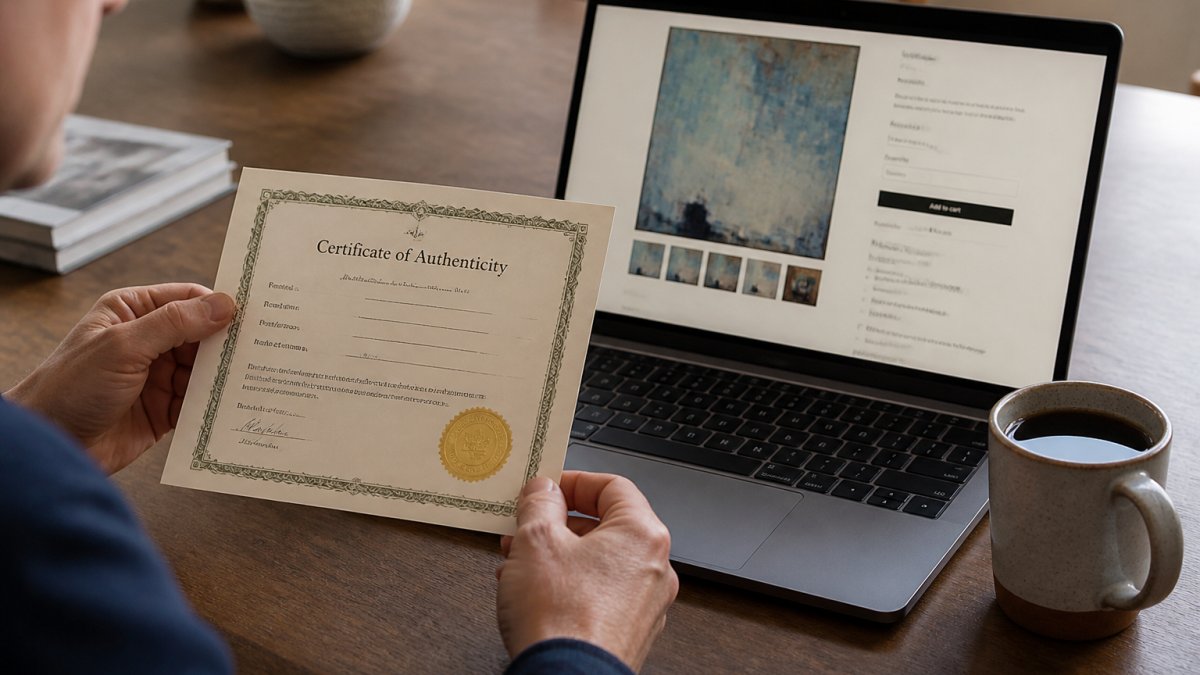
The documents that support ownership history usually include:
- Sales receipts or invoices showing each transfer
- Gallery or dealer records naming prior owners
- Auction records with lot numbers and dates
Chain of custody means an unbroken line from creator to you.
Paper certificates carry real weight in traditional sales, but they are only as good as the issuer. A certificate signed by the artist or a recognized gallery means something.
Certificates of Authenticity and Where They Fall Short
A certificate of authenticity confirms what the seller says about a piece. It does not independently prove it. Certificates are easy to copy and easy to fake.
Treat a certificate as one data point among many. Check who issued it, whether the issuer is contactable, and whether the details match the artwork exactly. A certificate that names the wrong size or title is worse than none at all.
Step 3: Verify Digital Artist Identity Before You Pay
Confirm the creator is a real, traceable person with a body of work behind them.
Then cross-check. Search the artist's name alongside the piece's title.
Watch for impersonation. Scammers sometimes copy real artists' images and sell them under slightly altered names.
If the artist sells directly, ask them to confirm the piece in writing. That one message closes most identity gaps.
Step 4: Check NFT Transaction History on the Blockchain
For tokenized art, the blockchain gives you a public record you can read yourself. NFT transaction history can show the wallets that have held the token, sales, and the minting date. That is checkable provenance, but only if you verify the right token on the right contract.
Work through these checks in order before you pay.
1. Confirm the token contract, not just the listing
Every NFT lives on a specific smart contract at a specific contract address, and each token has a token ID within that contract (ERC-721 Non-Fungible Token Standard). The marketplace page usually shows both, but do not trust the page alone. Cross-check the contract address against the artist's own website, their verified social profile, or a prior sale you can independently confirm.
- Match the contract address character-for-character against the artist's published address.
- Confirm the token ID matches the specific piece, not just the collection.
- Check whether the contract is a standard, widely used standard (for example, an ERC-721 contract on Ethereum) or a custom contract with unusual transfer rules.
2. Read the mint and transfer history on a block explorer
A block explorer lets you read the token's full history without trusting the marketplace. Open the contract, find the token ID, and review the transfer events from mint to the current holder.
What a clean history looks like:
- The first transfer is the mint, and it goes to a wallet the artist has publicly identified as theirs.
- Subsequent transfers correspond to sales the seller can document.
- The current holder matches the wallet the seller is asking you to pay.
What should make you slow down:
Fine Art Print – Dragon Fly Color the Sky →
- The mint wallet is brand new and has no other activity or connection to the artist.
- The token moved through several wallets in a short window with no corresponding sales records, a common pattern in wash trading and flip schemes.
- The seller asks you to send funds to a wallet that is not the current holder of the token.
3. Verify the creator's wallet, not just the token
A token proves a record exists on a ledger. It does not prove the person behind the wallet is the artist. Look for a verified creator profile on the marketplace, a wallet address the artist has published on their own site, and consistency between the two. If the artist has never publicly tied their identity to that wallet, ask them to confirm the wallet address in writing before you transact.
4. Check the marketplace listing and transfer mechanics
Before paying, confirm how the sale will actually execute. Is the seller using the marketplace's escrow-style transfer, or asking you to send crypto directly? Does the listing show the token as owned by the seller, or is it a listing on behalf of someone else? Off-platform transfers remove the marketplace's protections and are a common fraud vector.
- Prefer sales that execute through the marketplace's own contract.
- Confirm the listing is active and the seller still controls the token.
- Save the transaction hash after purchase, it becomes part of your provenance file.
5. Record what you verified
Screenshot the contract address, token ID, mint transaction, current holder, and the artist's wallet confirmation. Store them alongside your receipt.
Blockchain records are strong evidence of transfer history. They are weak evidence of authorship unless the creator's wallet is independently confirmed. Verify both, and treat the chain as one layer of provenance rather than the whole of it.
Step 5: Inspect the Original File, Metadata, and File Hash
For digital art, the file itself is part of the provenance. A seller can show you a perfect ownership record and still deliver a compressed screenshot, a re-exported copy, or a different file than the one the artist created. Verifying the file is how you confirm you are receiving the actual work and not a derivative.
Ask for the source file, not a delivery copy
Request the highest-resolution original the artist produced, typically a TIFF, PSD, or full-resolution PNG rather than a JPEG pulled from a marketplace page. Ask the seller to state the file's dimensions, color profile, and file size in writing before delivery, then compare what arrives against that description. A file that is smaller, recompressed, or missing layers is a different artifact, even if it looks identical on screen.
Read the embedded metadata
Most image files carry embedded metadata that can include the creator name, creation date, software used, and sometimes copyright fields. On many systems you can view it through the file's properties or with a metadata reader.
Check for:
- Creator or artist field matching the attributed artist.
- Creation date consistent with the artist's stated timeline.
- Software and camera or render information consistent with the artist's process.
Metadata is supporting evidence, not proof. It can be edited, stripped by export, or lost when a file passes through social platforms and messaging apps.
Compare file hashes
A cryptographic hash is a fixed-length fingerprint computed from the file's contents (Hash Functions). Change a single pixel and the hash changes completely. If the artist published a hash when the work was created, or recorded one on-chain, you can compute the hash of your copy and compare.
- Matching hashes confirm you hold a byte-identical copy of the file the artist hashed.
- A mismatch means the file differs in some way, even if the difference is invisible.
- No published hash means you cannot use this check; fall back to the artist's written confirmation and dated public postings.
Cross-check against public timestamps
Look for the earliest public posting of the work on the artist's own channels. A dated post, a portfolio entry, or an on-chain mint that predates the seller's listing supports the creation timeline. A piece that first appears on a reseller's page with no earlier trace is harder to verify and deserves more scrutiny.
Document the file you received
When the file arrives, record its hash, file size, dimensions, and metadata snapshot, and store them with your receipt and ownership records. That file-level record is what lets you, or a future buyer, confirm the work has not been swapped or altered. Provenance for digital art is not only a chain of owners; it is also a chain of files.
Step 6: Confirm Copyright, Licensing, and Commercial-Use Rights
Buying a piece does not automatically buy the copyright. Copyright stays with the creator unless a written agreement transfers it. This trips up more buyers than any other issue.
Ask three questions in writing:
- Do I own the copyright, or just the physical or digital copy?
- Can I display the work publicly, including in a business?
- Do I have commercial rights to reproduce or resell prints?
Get the answers in your sales record. A license that allows home display is very different from one that permits commercial use. Never assume.
Your Digital Art Purchase Checklist for Scams and Red Flags
Run every purchase through the same short list before money changes hands.
| Check | What to Confirm | Red Flag |
|---|---|---|
| Provenance | Unbroken ownership records | Vague or missing history |
| Authenticity | Matches artist's known work | Wrong size or title on papers |
| Attribution | Artist confirms in writing | Uncontactable creator |
| NFT records | Token ID and contract match | Wallet not tied to artist |
| File integrity | Hash and metadata align | Only screenshots offered |
| Rights | License stated in writing | Verbal promises only |
Payment red flags deserve their own warning. Watch out: requests for wire transfers, gift cards, or crypto sent to a personal wallet with no contract are the most common fraud pattern in art sales.
If provenance is incomplete, ask the seller to fill the gaps in writing. If it stays disputed, walk away.
For a broader look at safe online buying, read Is Buying Art Online Safe for Collectors? A 2026 Guide. And if a piece arrives and does not meet expectations, our guide on how to return art purchased online explains your options.
Browse Verified Originals at Just Art by John
Our original digital artworks include a signed Certificate of Authenticity confirming their status as one-of-one pieces by John Cranshaw. That gives you a documented starting point for your own provenance file.
You can browse the full John Cranshaw Giclees collection, or start with an original like Original Digital Art - Moon Café, a 36 x 24 in canvas at $295.00 with free shipping.

Frequently Asked Questions
What does provenance mean for digital art?
Digital art provenance is the documented record of where a work came from: who created it, when, and every owner it passed through. For a tokenized piece, that record includes wallet addresses and minting details on the blockchain. For a non-tokenized digital artwork, it means sales receipts, invoices, gallery records, and certificates of authenticity. Provenance supports authenticity and attribution but does not replace them, so treat it as one part of your verification.
How can I verify who created a digital artwork?
Start with the artist's portfolio and public presence, then cross-check the seller's claims against it. Look for a consistent body of work, a named studio or gallery relationship, and a signed certificate of authenticity that matches the listing. For tokenized pieces, confirm the creator wallet tied to the minting matches the seller. If the artist's identity cannot be traced beyond a marketplace profile, ask the seller for direct confirmation before paying.
Does blockchain prove that digital art is authentic?
No. A blockchain ledger confirms that a token exists, who minted it, and its transfer history, but it does not confirm that the minter was the actual artist or that the work is original. Someone can mint a copy of another creator's file. Treat the transaction history as evidence of ownership transfer, then verify artist identity and the original file separately before you buy.
What should I do if a digital artwork has no provenance records?
Ask the seller for a signed certificate of authenticity, a sales receipt, and the original file with its metadata intact. If none exist, treat the purchase as higher risk and price it accordingly. A legitimate gallery will supply documentation without pressure. For one-of-one originals, a signed certificate confirming the work's status is the minimum you should expect before transferring payment.
Verifying provenance takes a little work, but it protects every dollar you spend on art. We built Just Art by John around one-of-one originals, signed certificates, and free shipping so collectors can buy with confidence. Get started with Just Art by John and add a documented original to your collection today.
