


Table of Contents
- Artfinder vs UGallery: Quick Comparison for Art Buyers
- Artfinder Review: The Open Marketplace Model
- UGallery Review: The Curated Gallery Approach
- Artfinder vs UGallery: Fees, Commissions, and What Buyers Actually Pay
- How to Buy Original Art Online Without Getting Burned
- Best Websites to Buy Original Art: What Separates a Good Platform From a Bad One
- Conclusion: Choosing the Right Platform for Your Collection
- Frequently Asked Questions
Last Updated: October 9, 2026
Artfinder vs UGallery: Quick Comparison for Art Buyers
The choice between Artfinder vs UGallery for original art comes down to one question: do you want the widest possible selection, or do you want someone else to have already done the filtering? Artfinder is an open marketplace where thousands of independent artists list work directly. UGallery is a juried online gallery that accepts a small fraction of the artists who apply. Both sell original artwork online, but they serve different buyers.
At Just Art by John, we sell our own work directly, which gives us a clear view of how these platforms treat the people on both sides of a sale. Below, we break down fees, curation, authenticity, and shipping so you can pick the right source for your collection.
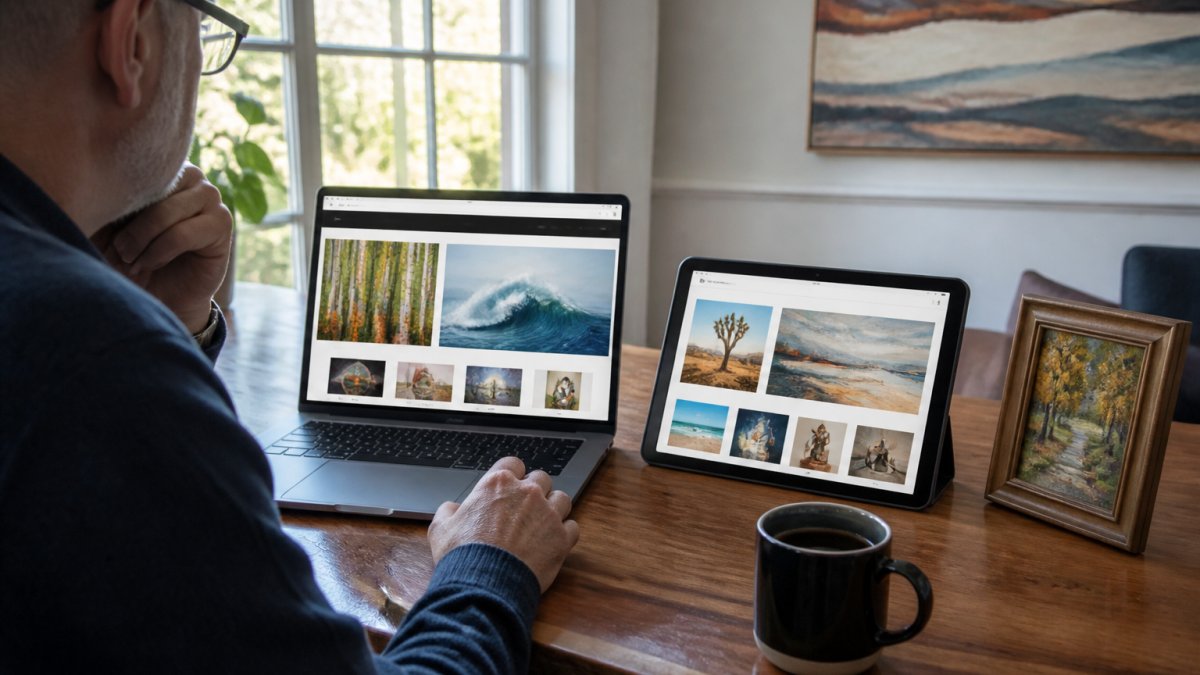
| Feature | Artfinder | UGallery |
|---|---|---|
| Model | Open marketplace | Curated gallery |
| Artist selection | Self-signup, broad | Juried application |
| Selection size | Very large | Smaller, vetted |
| Price range | Wide, entry to high | Mid to high |
| Best for | Browsing variety | Buyers who want guidance |
Artfinder Review: The Open Marketplace Model
Artfinder is an open art marketplace where independent artists create their own listings and set their own prices. That openness is the whole point: you get enormous variety across painting, printmaking, photography, and sculpture, often at entry-level prices you won't find in a traditional gallery.
The trade-off is consistency. Because artists self-manage their profiles, listing quality varies. Some sellers write detailed provenance notes; others post two blurry photos and a one-line description. A common mistake buyers make is judging a piece from a single image, then discovering the scale or color is nothing like they expected.
What most guides miss is that the marketplace model puts the verification work on you. Check the artist's profile, look at how long they've been selling, and read the listing's materials and dimensions carefully before you commit.
UGallery Review: The Curated Gallery Approach
UGallery operates on the opposite principle: it is a curated online gallery, and artists must apply and be selected before their work appears. That filter means fewer listings, but the ones you see have cleared a review of quality and presentation.
For buyers who feel overwhelmed by endless scrolling, this is the appeal. A curator has narrowed the field. Pricing tends to sit in the mid to high range because the gallery is positioning work as collectible rather than casual decor.
The limitation is range. A juried gallery carries a point of view, so if your taste runs outside it, you'll find nothing. It's also harder to negotiate or buy directly from the artist, since the gallery sits between you and the maker.
Artfinder vs UGallery: Fees, Commissions, and What Buyers Actually Pay
Most comparison articles wave at "commission" without explaining who pays it or how it reaches the buyer's total. Here is the mechanism, then the buyer-side math.
How the commission works on each platform. On an open marketplace, the artist sets the retail price and the platform keeps a percentage of each sale as its cut. The artist receives the remainder. On a juried gallery, the gallery typically sets or approves the retail price and keeps a larger share, because it is providing curation, marketing, and often a consignment-style relationship. In both models, the commission is baked into the listed price. You are not charged a separate "platform fee" at checkout on top of the sticker price. What you see is what the platform and artist agreed the work is worth after the split.
That single fact answers the most common buyer question: no, you do not pay double. The commission is a seller-side cost that has already been absorbed into the number on the listing.
What actually lands in your cart. Four line items determine your real total:
- Listed price, commission already included, no add-on platform fee at checkout
- Shipping, usually quoted separately, and it swings widely by size, weight, and whether the work is framed
- Sales tax, applied based on your shipping address and the platform's nexus obligations
- Framing and hanging hardware, extra unless the listing states otherwise
Why shipping is the line item that surprises buyers. A stretched canvas over roughly 48 inches on its longest side often cannot move through standard parcel networks and shifts to freight, which is quoted per shipment rather than per box. A small unframed work on paper may ship flat for a fraction of that. Two paintings at the same price can therefore differ by hundreds of dollars in delivered cost. Always request a written shipping quote before you commit on anything large.
The seller-side picture, for context. If you also sell, the split matters to you. Open marketplaces generally advertise lower commission percentages but hand you the marketing, photography, and customer service. Juried galleries take a larger share but supply the audience and the vetting. Because both platforms revise these terms periodically, treat any percentage you read in a blog post as stale until you confirm it on the platform's own seller or help pages. Check the date on whatever page you land on.
A buyer-side cost checklist. Before checkout, confirm in writing:
- Whether shipping is included, quoted separately, or estimated
- Whether the quoted shipping covers insurance for the full sale value
- Whether sales tax will be added at checkout based on your address
- Whether the frame shown in the photo is included
- Whether any customs or import charges apply if the artist ships from outside the country
For your rights if a transaction goes wrong, the Federal Trade Commission's guidance on buying online covers mail, internet, and telephone order rules, including what a seller owes you when goods are not delivered as described.
How to Buy Original Art Online Without Getting Burned
Buying original art online safely comes down to verifying the work, the seller, and the return terms before money changes hands. Most disputes trace back to a skipped step, not a dishonest seller.
Work through this checklist:
- Confirm the piece is original, not a reproduction, in the listing text
- Ask for a certificate of authenticity or a signed provenance note
- Request additional photos in natural light
- Verify dimensions in inches or centimeters before you buy
- Read the return window and who pays return shipping
- Check how damage in transit is resolved
- Confirm the seller's identity and selling history
The Federal Trade Commission's guidance on buying online is a useful reference for your rights if a purchase goes wrong. Authenticity matters most with original art: a print is not a painting, and a listing should say which it is. Reputable sellers document provenance, and the U.S. Copyright Office explains how artists' rights attach to original works.
Best Websites to Buy Original Art: What Separates a Good Platform From a Bad One
The best websites to buy original art online share a few traits: clear authenticity documentation, transparent shipping and return policies, and real artist profiles you can verify. Everything else is decoration.
When you compare platforms, grade them on these criteria:
- Authenticity: does the listing state original vs. print, and is provenance documented?
- Artist transparency: can you see who made it and their body of work?
- Shipping clarity: are costs and timelines stated before checkout?
- Return policy: is there a real window, and who covers return shipping?
- Buyer protection: what happens if the piece arrives damaged or not as described?
A platform that answers all five is worth your money. One that dodges even two is a risk. This is also where buying directly from an artist's own gallery can simplify things: you deal with the maker, not an intermediary.
Conclusion: Choosing the Right Platform for Your Collection
The hardest part of buying original art online isn't finding something you like. It's trusting that what arrives matches what you saw, and that you're protected if it doesn't. Artfinder gives you range; UGallery gives you a filter. Neither removes the need to verify.
At Just Art by John, we take a different route. Every piece is created personally by John Cranshaw, so you know exactly who made your work. Our collection spans original paintings, fine art Giclèe prints, and sculpture, and each piece comes with the maker's name attached, not a stranger's.
View cart and start your collection with a piece you can trace to the artist's own hand.
Frequently Asked Questions
How does Artfinder compare with UGallery for buying original art?
Artfinder operates as an open marketplace with thousands of independent artists, so selection is broad but quality varies. UGallery runs a juried gallery model with a smaller, vetted roster, which means less inventory but more consistent curation. Both handle shipping and buyer protection, but UGallery typically offers more white-glove support, while Artfinder gives you wider price ranges and styles to explore.
What should you compare before buying original art online?
Check four things: whether the piece is one-of-a-kind or a reproduction, the return and damage policy, and the authenticity documentation provided. On Artfinder, look at the artist's profile and reviews. On UGallery, the curation already filters many risks. Always confirm shipping insurance and whether returns are accepted within a set window.
How do Artfinder and UGallery handle shipping and returns?
Both platforms require sellers to ship with tracking, and both offer buyer protection if a piece arrives damaged or not as described. UGallery coordinates shipping more directly and often includes insurance in the listed price. Artfinder leaves shipping arrangements to individual artists, so costs and timelines vary. Returns are typically accepted within a short window (often 7-14 days), but you must report damage immediately with photos.
How can you tell whether an online artwork is an original?
Look for a signed certificate of authenticity, a clear description stating 'original' versus 'print' or 'reproduction,' and high-resolution images showing brushwork or texture. On Artfinder, check the artist's profile for exhibition history. On UGallery, the gallery vets each piece. If the listing is vague, ask the seller directly for provenance and medium details before purchasing.