

Table of Contents
- Step 1: Verify the Artist's Background Before You Buy
- Step 2: How to Verify Art Authenticity and Certificates of Authenticity
- Step 3: Questions to Ask Art Sellers Before Committing
- Step 4: Evaluate Return Policies, Shipping Insurance, and Handling Logistics
- Step 5: Spot Red Flags in Online Listings and Seller Reputation
- Step 6: Physical Inspection Checklist for Your Artwork
- Step 7: Collecting Fine Art on a Budget Without Compromising Quality
- Conclusion: Buying Art Online Safely Starts With Preparation
- Frequently Asked Questions
Last Updated: September 20, 2026
Step 1: Verify the Artist's Background Before You Buy
Buying art online starts with one question: is this artist real? According to guidance from the U.S. Federal Trade Commission on online shopping, buyers should research sellers before paying. At Just Art by John, every piece comes from one named artist, John Cranshaw, so the person behind the work is never a mystery.
- A full artist biography with training and career details
- Exhibition history, past shows, or gallery listings
- A consistent body of work across several years
- Real photos of the artist working in a studio
Checking Artist Biography and Exhibition History
An artist biography is the written record of an artist's training, exhibitions, and career. Read it closely. Vague bios with no dates or venues are a warning sign. A real bio names schools, shows, and collections.
Understanding Gallery Representation vs. Direct-from-Artist Sales
Gallery representation means a gallery sells the artist's work and takes a cut. Direct from artist sales skip the middleman. Direct sales often cost less and let you talk to the creator. Galleries add curation and sometimes resale value.
Step 2: How to Verify Art Authenticity and Certificates of Authenticity
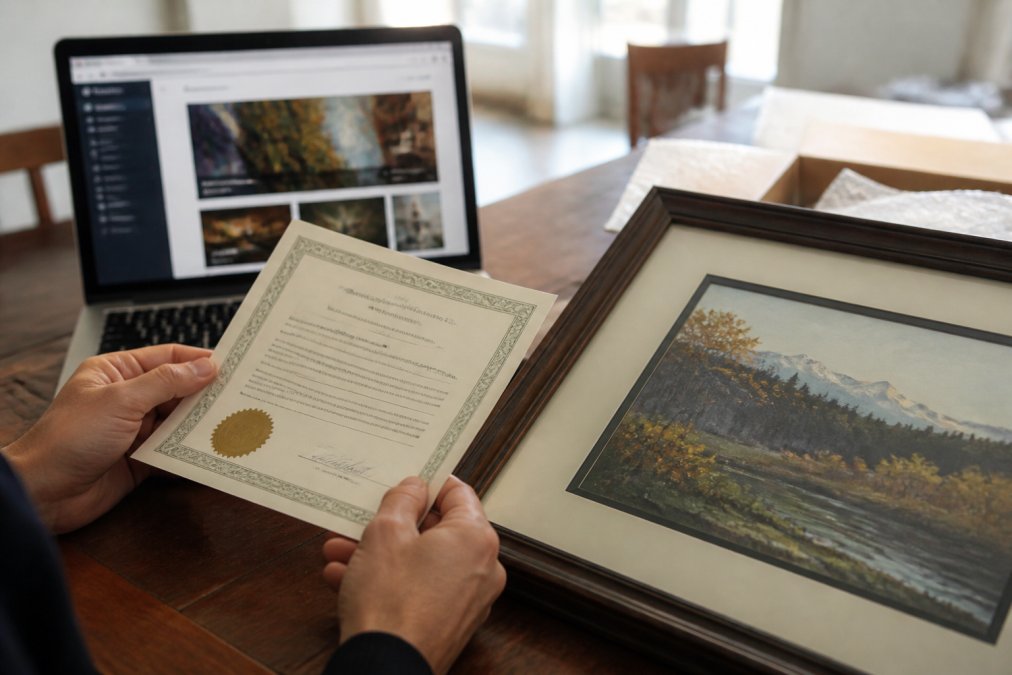
The best way to verify art authenticity is to match the certificate of authenticity to the artwork itself. Check the title, medium, dimensions, and date against the listing. Any mismatch is a red flag.
What a Certificate of Authenticity Should Include
A proper certificate names the artist, the title, the medium, the size, and the year. It should carry a signature or digital signature and a unique ID number. Request a photo of the certificate before buying.
Digital Provenance and Blockchain Verification
Provenance is the documented history of who owned a piece and when. Digital provenance records that history online, and some sellers use blockchain to lock it in place. This matters most for limited edition prints, where the edition number proves scarcity.
Step 3: Questions to Ask Art Sellers Before Committing
Ask questions before you pay, not after. A serious seller answers fast and in detail. Vague answers tell you plenty. The goal is to force the seller to commit to specifics in writing, because a written answer is what you rely on if the piece arrives wrong.
Start with these:
- Is this an original artwork, a limited edition print, or an open-edition reproduction?
- Can you send high-resolution images from multiple angles, including the back, the signature, and any framing hardware?
- What is the exact size, including the frame, in inches?
- How will you ship it, and is it insured for the full purchase price?
- What is your return policy, in writing, including the return window and who pays return shipping?
- Can you provide the certificate of authenticity before I pay?
- Who is the legal seller of record, and what is their business address?
Payment Protection and Escrow Services for High-Value Transactions
Escrow is a service where a neutral third party holds your money until the artwork arrives and you confirm it matches the description. The seller does not get paid until you release the funds. If the piece never arrives or arrives materially different, the escrow agent returns your money. This is the single strongest protection available for a high-value art purchase, and most beginner guides skip it entirely.
How escrow works in practice, step by step:
- You and the seller agree on terms: price, shipping method, inspection window, and what counts as "as described."
- You send funds to the escrow agent, not the seller.
- The agent confirms receipt and notifies the seller to ship.
- You receive the piece and inspect it within the agreed window (commonly 3-10 days).
- You either release the funds or file a dispute with the agent.
- If you dispute, the agent holds the money until the issue is resolved.
Secure Payment Methods and What to Avoid
Always pay through a secure payment gateway with buyer protection, a major credit card, a recognized payment processor, or a licensed escrow service. Each of these gives you a dispute path if the transaction goes wrong.
A few practical rules:
- Never send payment to a name that does not match the seller's stated business identity.
- Never pay off-platform after being contacted through a marketplace, that is how most art scams succeed.
- Keep every message, invoice, and listing screenshot. If you dispute later, that record is your evidence.
- If the seller pressures you to decide "today" or "before someone else buys it," slow down. Urgency is a tool, not a courtesy.
Questions That Reveal a Seller's Real Answers
Some questions are designed less to get information than to see how the seller reacts:
- "Can you send a short video of the piece on a wall or easel?" A real seller can. A scammer using stolen photos cannot.
- "What is the edition number on this print, and how many were made?" Vague answers on a supposedly limited edition are a red flag.
- "Has this piece been exhibited or published anywhere?" Provenance questions separate owners from resellers of stolen images.
- "Can you put the return terms in the invoice?" If the seller refuses to write it down, the policy does not exist.
Step 4: Evaluate Return Policies, Shipping Insurance, and Handling Logistics
A clear return policy is the difference between a safe purchase and a gamble. Read it before you buy, not after. Look for the return window, who pays return shipping, and what condition rules apply.
Customs, Duties, and International Tax Implications
Buying from another country adds customs documentation, import duties, and possible sales tax. These costs land on you, the buyer, and they are not refundable if you return the piece. Ask the seller who handles the paperwork before you commit.
| Risk | What to Check | Why It Matters |
|---|---|---|
| Damage in transit | Shipping insurance | Covers repair or refund |
| Wrong item | Return policy window | Lets you send it back |
| Import fees | Customs documentation | Avoids surprise charges |
| Payment fraud | Escrow or secure gateway | Protects your money |
Step 5: Spot Red Flags in Online Listings and Seller Reputation
Red flags show up in patterns, not single details. One odd photo means little. Three odd details mean walk away.
Watch for these:
- Prices far below the artist's normal range
- Blurry or watermarked high-resolution images
- No seller reputation, reviews, or history
- Pressure to pay off-platform
- Stock photos instead of real shots of the piece
Step 6: Physical Inspection Checklist for Your Artwork
Inspect the piece the day it arrives. Most return policies and escrow inspection windows start counting from delivery, not from when you get around to opening the box. A common pattern is a 3-7 day window for reporting damage or mismatch, and once it closes, your leverage drops sharply.
Before You Open the Box
Do this before you touch the artwork:
- Photograph the sealed box from every side, including the shipping label.
- Note any visible dents, punctures, water stains, or crushed corners on the outer packaging.
- If the box is visibly damaged, photograph it before opening and consider filming the unboxing.
- Keep all packing materials until you have fully inspected the piece and confirmed it is correct.
The Inspection Checklist
Work through these in order and photograph each step:
- Match the certificate of authenticity to the artwork: title, medium, dimensions, year, and edition number must all agree.
- Check the signature and date against the listing photos and the certificate.
- Measure the piece yourself, including the frame, and compare to the listed size. A difference of more than a fraction of an inch is worth documenting.
- Inspect the surface under raking light for cracks, craquelure, fading, water damage, scratches, or inpainting.
- Check the back of the canvas or panel for labels, stamps, gallery stickers, or prior framing marks that support the provenance story.
- Confirm the frame and any glass are intact and that the piece is not loose in the frame.
- Compare the piece side by side with the listing photos. Color shifts can be photography, but composition, brushwork, and details should match.
- Photograph any flaw immediately, with a ruler or coin in frame for scale.
What to Do If Something Is Wrong
If the piece does not match the listing, act in writing and act fast:
- Do not alter, reframe, or hang the piece. Altering it can void the return.
- Email the seller the same day with photos and a clear description of the problem.
- State what you want: a refund, a replacement, or a price adjustment.
- If you paid through escrow, file a dispute with the escrow agent before the inspection window closes.
- If you paid by credit card, you generally have a dispute window measured in weeks, not days, but start the process immediately and keep the paper trail.
- If the seller goes silent, escalate to the marketplace, the payment processor, or the escrow agent. Do not wait for the seller to respond before starting the dispute.
Documenting for Insurance and Resale
Even when nothing is wrong, keep the record. Photograph the piece, the certificate, the invoice, and the shipping label, and store them together. If you ever insure the piece, sell it, or donate it, that documentation is the provenance file. Buyers and insurers ask for it, and reconstructing it later is far harder than capturing it on day one.
Step 7: Collecting Fine Art on a Budget Without Compromising Quality
Collecting fine art on a budget is possible if you know where to look. Limited edition prints and Giclèe prints cost less than originals while keeping the artist's real work. Start with one piece you love, then build slowly.
Conclusion: Buying Art Online Safely Starts With Preparation
Buying art online safely comes down to preparation, not luck. Check the artist, verify the certificate, ask hard questions, and pay through a protected channel. Just Art by John offers original works, fine art Giclèe prints, and sculpture, all created by John Cranshaw, with the artist's background and body of work open for you to review.
Frequently Asked Questions
Is it safe to buy art online from independent artists?
Buying art online from independent artists can be safe when you take the right precautions. Verify the artist's biography and exhibition history, request a certificate of authenticity, and use secure payment methods like credit cards or escrow services. Ask questions about provenance and return policies before committing. Independent artists often provide more personal service and transparency than large marketplaces, but the same verification steps apply regardless of where you buy.
How can I verify the authenticity of a piece of art purchased online?
Start by requesting a certificate of authenticity that includes the artist's name, title, medium, dimensions, and date of creation. Cross-reference the artist's biography and gallery representation through their website or professional databases. Ask for high-resolution images showing details, signatures, and condition. For higher-value pieces, consider a professional art appraisal or third-party authentication service. Digital provenance tools and blockchain verification are emerging options for tracking ownership history.
What payment methods offer the most protection for art buyers?
Credit cards and PayPal offer strong buyer protection, including dispute resolution and chargeback options. For high-value transactions, escrow services hold funds until you receive and inspect the artwork, releasing payment only after you confirm satisfaction. Avoid wire transfers, cryptocurrency, or peer-to-peer payment apps that lack recourse. Always use a secure payment gateway and keep records of all communications and transaction details.
Should I ask for a Certificate of Authenticity when buying art online?
Yes. A certificate of authenticity is your primary proof that the artwork is genuine and created by the named artist. It should include the artist's signature, title, medium, dimensions, edition number for prints, and date. For limited edition prints, the certificate confirms the edition size and your print's number within that run. Without a certificate, verifying authenticity becomes much harder, and resale value may suffer. Always request one before finalizing your purchase.