

Table of Contents
- What Separates High Quality Art From Decorative Prints
- How to Spot a High Quality Giclee Print
- Signs of Original Artwork Authenticity
- Reading Composition, Color, and Technique Like a Collector
- The Tactile Inspection Guide: What to Look For in Person
- Collecting Fine Art on a Budget Without Sacrificing Quality
- Caring for Your Art: Maintenance and Longevity
- Conclusion
- Frequently Asked Questions
Last Updated: September 14, 2026
What Separates High Quality Art From Decorative Prints
Learning how to tell if art is high quality starts with one distinction: a decorative print is manufactured to fill a wall, while a quality artwork is made to hold attention for decades.

The difference shows up in three places: materials, originality, and intent. Mass-produced prints use inexpensive paper and dye-based inks that fade within years; quality work uses archival materials, pigment-based ink, and deliberate composition.
This guide breaks down how to tell if art is high quality using the same checks a gallery uses: paper and ink, provenance, composition, and tactile inspection.
How to Spot a High Quality Giclee Print
A high quality giclée print is a reproduction made with pigment-based ink on acid-free paper, printed at high resolution on a substrate built to last. The term "giclée" only describes the printing method, so the label alone proves nothing.
Paper, Ink, and Resolution Checks
Ask three questions about any print: What paper, what ink, what resolution?
- Paper: Look for acid-free or archival stock. Cheaper papers yellow and become brittle.
- Ink: Pigment-based ink resists fading far better than dye-based ink.
- Resolution: A sharp print is typically 300 dpi or higher, with enough color gamut to hold subtle transitions.
The Library of Congress guidance on care of prints and drawings recommends acid-free materials for long-term storage, which is the same standard a quality print should meet before it ever reaches your wall.
Signs of Original Artwork Authenticity
Genuine original artwork carries evidence of its own making: a hand-signed signature, documented provenance, and often a certificate of authenticity. Reproductions rarely survive all three checks. But the modern market has a fourth category most guides ignore: mass-produced work dressed up to look like an original, sold through storefronts that never touch the artist.
Provenance, Signatures, and Certificates
Provenance is the documented history of an artwork's ownership. A strong chain includes receipts, gallery records, or exhibition history; a weak one is a single invoice from an unfamiliar seller.
A certificate of authenticity is a signed document from the artist or gallery confirming the work's origin, title, medium, and date. It is not a legal guarantee, but look for a physical certificate whose signature matches the artwork, not a PDF template with a typed name.
Signatures should be consistent with the artist's known body of work. A hand-signed, numbered, dated limited edition carries more weight than an unsigned open-edition print. Compare the signature to those on the artist's website or past sold works; inconsistency in letterforms, pressure, or placement is a red flag.
The 'Fake' Market: Red Flags for Dropshipped Art
The fastest-growing problem in online art sales is mass-produced work marketed as original artist output, typically printed overseas, warehoused domestically, and shipped under a storefront name that implies a studio. Watch for:
- No artist name, only a brand name. If no individual artist is named, credited, or linked to a portfolio, treat the work as decorative, not original.
- Identical listings across multiple storefronts. Reverse-image search the artwork. If the same image appears under three seller names, it is a mass-produced file.
- Stock-photo staging. Original artists usually photograph work in their own studio. Dropshipped listings reuse the same mockup templates across dozens of products.
- Pricing that undercuts materials cost. A large canvas print priced below what the canvas and ink would cost at retail signals the seller is not the maker.
- No process documentation. Real artists show works in progress or studio shots. A seller with only finished product images is likely reselling.
- Vague or copied artist bios. Run the bio text through a search engine. If it appears verbatim on other storefronts, it was copied from a template.
- Shipping from a fulfillment center, not a studio. If the tracking origin is a third-party warehouse and the seller cannot explain why, ask directly.
No single red flag is conclusive, but two or three together are enough to walk away.
How to Verify Before You Buy
A short verification sequence catches most problems:
- Ask for the artist's full name and a link to their portfolio or social presence.
- Request a photo of the actual piece, ideally with a hand or ruler for scale.
- Ask for the certificate of authenticity before payment, not after.
- Pay with buyer protection. Credit cards and major platforms offer dispute rights that wire transfers and peer-to-peer apps do not.
- Get the return policy in writing. A seller who refuses returns on original art is protecting a fragile margin or hiding something.
The U.S. Copyright Office overview of visual arts registration explains how artists register original works, which helps collectors understand what official documentation looks like. The [FTC guidance on buying and selling art online(/blogs/news/is-buying-art-online-safe-for-collectors) | ftc.gov] covers disclosure rules that protect buyers when a listing misrepresents what is being sold.
Reading Composition, Color, and Technique Like a Collector
Composition is the arrangement of visual weight across a surface: where the eye lands, rests, and moves. A well-composed piece holds attention without feeling crowded; a weak one scatters your eye with no anchor or pins it to one spot.
A Concrete Composition Checklist
Instead of asking "is this good," run the piece through specific structural tests:
- Focal point: Squint at the work. The first shape that survives the squint is your focal point. If nothing survives, the piece has no hierarchy. If three things compete equally, it has no anchor.
- Rule of thirds: Imagine the surface divided into a 3x3 grid. Strong compositions usually place the primary subject near one of the four intersection points, not dead center. Dead-center placement can work, but it is a deliberate choice, not a default.
- Leading lines and eye path: Trace where your eye travels. A well-built piece moves you from the focal point outward along edges, color transitions, or repeated shapes, then returns you. If your eye exits the frame and never comes back, the composition leaks.
- Negative space: Look at what the artist left empty. Amateur work fills every inch. Confident work uses empty space to give the subject room to breathe.
- Value contrast: Convert the image mentally to grayscale. If the light and dark shapes still read clearly, the piece has strong value structure. If it turns to mud, the artist relied on color to do work that value should be doing.
Color Accuracy: Reproduction vs. Original
For a reproduction, color accuracy means the print matches the original. Ask whether the print was proofed against the original or a digital file. A giclée proofed against the physical painting holds subtler transitions in skin tones, skies, and shadows than one pulled from a screen-calibrated file alone.
For an original, color accuracy is the wrong question. The right question is whether the color feels intentional. Look for a consistent palette logic: does the artist repeat a hue in three or four places to tie the piece together, or does color appear randomly? Random color usually signals an inexperienced hand.
Technique: Reading the Surface
Technique is the physical evidence of how the work was made, and it is the hardest thing to fake.
- Brushwork: Look for variation in stroke width, pressure, and direction. Uniform strokes suggest a mechanical process or a stencil.
- Layering: Quality paintings often show glazes, scumbles, or opaque passages over transparent ones. Tilt the work toward light and look for depth in the paint film.
- Edges: Hard edges, soft edges, and lost edges should all appear in a mature painting. A piece where every edge is equally sharp reads as flat.
- Signature integration: A signature painted into the wet surface sits in the same plane as the image. A signature added later in a different medium often floats above it.
Originality and Intellectual Content
Originality is not novelty. A piece can work in a familiar genre and still be original if the artist brings a distinct point of view, subject, or technical approach. The test is whether it adds something to its conversation or merely repeats it.
This is where objective and subjective judgment meet. Materials, provenance, and technique are objective; whether a piece moves you is subjective, and should be. Buy only on objective markers and you get a technically correct but emotionally empty wall; buy only on feeling and you get pieces that fall apart in ten years. The strongest collections are built on both.
The Tactile Inspection Guide: What to Look For in Person
In-person inspection reveals what photographs cannot: surface texture, impasto depth, and true pigment color under natural light. If you can view a piece before buying, do it.
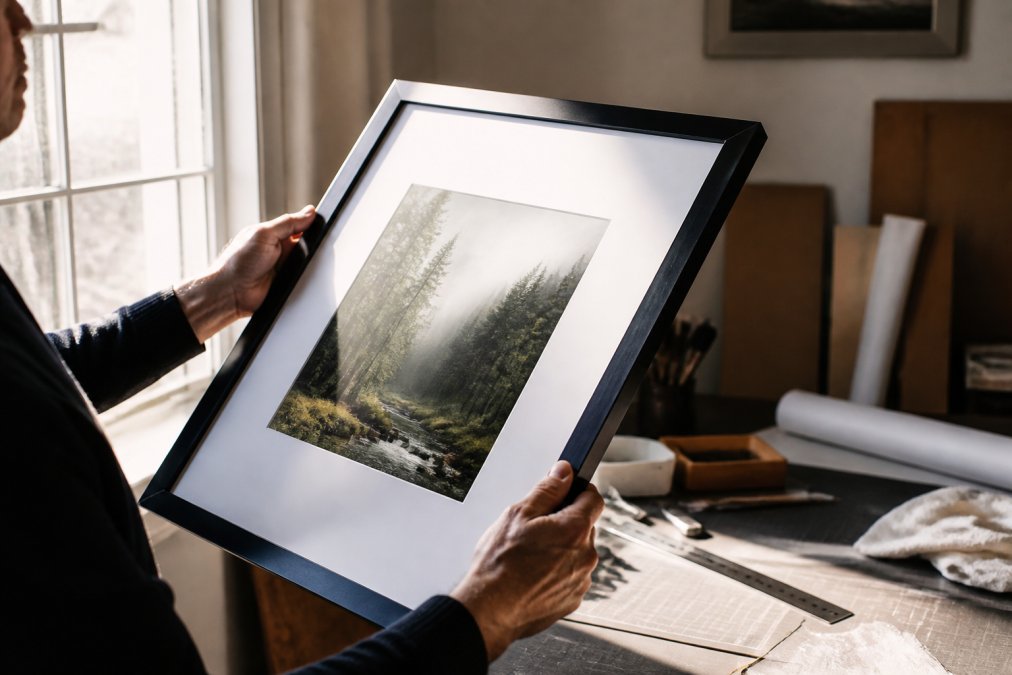
Tilt the work toward a light source and look across the surface at a low angle, a technique called raking light. On an original painting, you should see brushwork ridges, canvas weave, or layered pigment. On a giclée print, you should see an even ink surface with no banding or dot pattern.

Run a fingertip along an edge: a quality frame has a clean finish with no gaps, rough corners, or visible staples. Check the backing too, acid-free backing and proper mounting protect the work for decades.
Collecting Fine Art on a Budget Without Sacrificing Quality
Collecting fine art on a budget comes down to buying fewer, better pieces instead of filling walls with quantity. Strong collections start small and buy with intention.
A practical approach:
- Set a per-piece budget and hold to it rather than stretching for one purchase.
- Prioritize originals and limited editions over open-edition reproductions.
- Buy directly from artists where possible, which often means better pricing and a direct provenance record.
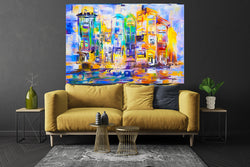
Original paintings such as Sunday Morning can be a starting point for a new collector. The FTC guidance on buying and selling art online is worth reading before any online purchase, since it covers disclosure rules that protect buyers.

| Budget Tier | What to Look For | Typical Trade-Off |
|---|---|---|
| Entry | Limited-edition giclée print, hand-signed | Smaller size, higher edition number |
| Mid | Small original painting or study | Less established artist |
| Higher | Larger original, documented provenance | Longer saving period |
Caring for Your Art: Maintenance and Longevity
Maintenance is where most collections quietly lose value. Hanging a piece in direct sunlight or above a heat source shortens its life more than almost anything else.
Keep these rules in mind:
- Hang away from direct sunlight and windows. UV exposure fades pigment over time.
- Avoid bathrooms, kitchens, and any wall above a radiator or vent. Humidity swings damage paper and canvas.
- Dust framed work with a soft, dry cloth on the frame only, never on the artwork surface.
- Have significant pieces professionally cleaned or re-framed if the backing or mounting shows signs of age.
The National Gallery of Art conservation guidance offers detailed recommendations on environmental conditions for works on paper and canvas, which is worth reviewing if you own several pieces.
Conclusion
The hardest part of collecting is not spotting quality once you know what to look for. It is trusting your own judgment the first time you commit to a piece.
Just Art by John offers original paintings and fine art giclée prints, each created by John Cranshaw. Browse the collection, including original works like Dark Flowers on a Wall and White Flowers on a Fence, and see the difference a well-made piece makes in your space.
Get started with Just Art by John.
Frequently Asked Questions
What is considered high quality art?
High quality art combines several measurable factors: archival materials that resist fading, a strong composition with clear visual weight, and genuine artistic intent rather than mass-produced design. For prints, look for pigment-based ink on acid-free paper with a stated dpi and color gamut. For originals, check for visible brushwork, a hand-signed signature, and documentation like a certificate of authenticity. Subjective appeal matters too, but these objective markers separate gallery quality work from decorative reproductions.
How can you tell if a painting is authentic?
Start with provenance: a documented history of ownership, gallery receipts, or exhibition records. Check the signature against known examples of the artist's hand, and examine the back of the canvas for labels, stamps, or inscriptions. Original paintings show texture and brushwork that prints cannot replicate, and the paint should sit on the surface with natural variation. A certificate of authenticity from the artist or gallery adds confidence, especially when buying online.
What are the signs of a high-quality art print?
A high-quality art print uses pigment-based ink rather than dye, which resists fading for decades. The substrate should be acid-free paper or canvas, often labeled archival or museum grade. Check the resolution: 300 dpi or higher preserves fine detail. Giclee prints should show smooth color transitions without banding, and the color gamut should match the original artwork closely. A hand-signed edition number and certificate of authenticity are strong indicators of quality.
How do you start collecting fine art on a budget?
Begin with limited edition prints from artists you admire, which offer gallery quality at a fraction of original painting prices. Set a per-piece budget and prioritize archival materials and provenance over size. Emerging artists and direct-from-studio sales often provide better value than secondary market markups. Build relationships with galleries, ask about payment plans, and focus on pieces you will enjoy living with rather than speculative resale value.