

Table of Contents
- Giclee Prints vs Original Art: What's the Real Difference?
- Price Comparison: Giclee Prints vs Original Art
- The Archival Quality of Giclee Prints Explained
- How to Display Giclee Prints in Your Home
- Fine Art Giclee Prints for Modern Living Spaces
- Investment Value: Which Holds Up Over Time?
- Which Option Fits Your Space and Budget?
- Frequently Asked Questions
Last Updated: September 18, 2026
Giclee Prints vs Original Art: What's the Real Difference?
The difference between giclee prints and original art: one is a reproduction, the other a one-off piece. That fact drives price, longevity, investment potential, and how each piece lives in your home. This guide from Just Art by John breaks down where each option wins and how to decide which belongs on your wall.
How Giclee Prints Are Made
A giclee print is a high-resolution reproduction created with an inkjet printer using pigment-based inks on fine art paper or canvas. The process starts with digital scanning or direct capture of the original, then printing at resolutions that preserve subtle brushwork and color gradation.
What Makes Original Art Different
An original painting is a one-off piece made by the artist's hand, no reproduction step, no printer, no separate substrate. The texture, brushwork, and decisions made in the moment exist in that single object.
Price Comparison: Giclee Prints vs Original Art
At Just Art by John, a gallery-wrapped canvas giclee starts at $325.00, while original paintings range from $995.00 to $1,095.00. That gap is typical: the giclee price buys the same composition and color fidelity, printed on canvas with archival inks, while the original price buys the physical artwork itself, the actual paint and surface the artist created.
What You Get at Each Price Point
Format |
Example Piece |
Price |
What You Receive |
|---|---|---|---|
Original Painting |
$995.00 |
One-of-a-kind hand-painted artwork |
|
Original Painting |
Dreaming of my flowers |
$1,095.00 |
One-of-a-kind hand-painted artwork |
Giclee Print |
White flowers on the fence "Giclèe" |
$325.00 |
Gallery-wrapped canvas reproduction |
Giclee Print |
Dark Flower on a Wall "Giclèe" |
$325.00 |
Gallery-wrapped canvas reproduction |
A common mistake is assuming the giclee is a lesser version. It is not, it is a different product with a different purpose. The original is the artwork; the giclee is how you bring it into a space at a price that fits a real budget.

The Archival Quality of Giclee Prints Explained
The archival quality of a giclee print is not a marketing claim, it is a measurable property determined by three variables: ink chemistry, substrate, and display environment. Get all three right and a print can hold its color for generations; get one wrong and the lifespan collapses.
The Three Variables That Determine Lifespan
1. Ink chemistry. Pigment inks use insoluble color particles suspended in a carrier; those particles sit on the substrate surface and resist breakdown from light and oxygen. Dye-based inks dissolve into the paper and fade from the inside out, the biggest fork between a true giclee and a standard digital print. Most fine art printers use eight to twelve pigment inks.
What the Standards Actually Say
The Library of Congress guidance on inkjet print preservation notes that pigment inks on appropriate substrates are among the most stable color printing methods available. The Image Permanence Institute publishes the standardized tests, light fade, dark stability, and water resistance, that manufacturers use to rate a print's expected life. When a print is described as "archival" or "museum-grade," it should be backed by one of these test protocols, not just a label.
Maintenance and Care: The Part Most Guides Skip
Longevity is not just about what you buy, it is about how you keep it. A few habits extend any print's life:
- Glazing matters more than the frame. UV-filtering glass or acrylic blocks the most damaging wavelengths; standard glass blocks almost none. For a paper giclee, UV glazing is the highest-return upgrade.
- Use spacers or a mat. Paper prints should never touch the glazing, condensation inside the glass can cause mold or ink migration.
- Dust with a dry, soft brush. A dry microfiber cloth or soft artist's brush is enough for canvas. Never use glass cleaner, ammonia, or a damp cloth, moisture can drive pigments into the substrate.
- Control humidity. Bathrooms, basements, and kitchens are the worst rooms for art. Aim for stable indoor relative humidity of roughly 40 to 60 percent, and avoid hanging above radiators, vents, or fireplaces.
- Rotate, don't relocate. If a piece sits in a bright room, rotating it to a shadier wall every few months spreads light exposure rather than concentrating it.
Where Giclee Prints Fall Short
The limitation of a giclee is not longevity, it is physical uniqueness. A well-made giclee will outlast most furniture, but it will never have the tactile surface of an original: raised brushstrokes, layered impasto, slight variations in sheen. No printer reproduces three-dimensional paint texture; it reproduces the image of it. A giclee can match an original's color and composition for decades, but not its surface.
How to Display Giclee Prints in Your Home
Displaying a giclee print well comes down to two decisions: how you frame or mount it, and where you hang it. Both affect how the piece reads and how long it lasts.
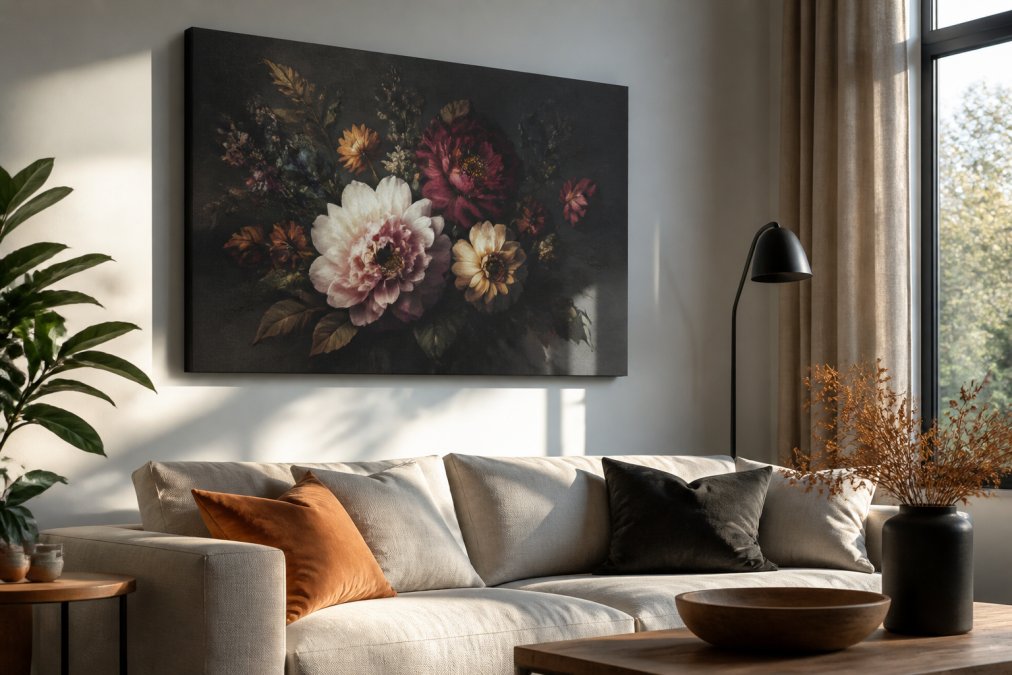
Framing and Canvas Options
- Gallery-wrapped canvas: No frame needed, edges finished, best for contemporary interiors
- Traditional framing: Adds a border and mat, suits classic or formal rooms
- Floating frame: A thin frame with a small gap around the canvas, a middle-ground option
- Unframed paper print: Lowest cost, but requires careful handling and a frame to protect it
For most homes, gallery-wrapped canvas is the simplest path: it arrives ready to hang, and the canvas texture adds visual depth a flat paper print lacks.
Fine Art Giclee Prints for Modern Living Spaces
Fine art giclee prints for modern living spaces solve a specific problem: getting real artistic quality on a wall without the original-art price tag. The answer is a reproduction good enough that most guests will not know the difference unless they look closely.
Investment Value: Which Holds Up Over Time?
Original art holds investment value because it is a one-off piece with fixed supply. Giclee prints hold aesthetic value but rarely appreciate, since they can be reproduced. But "originals appreciate" is not automatically true, it depends on the artist, the market, and the piece.
What Actually Drives Art Value
Art appreciates when demand for a specific artist's work outpaces supply. Four factors drive that:
- Artist reputation and trajectory. A piece by an artist whose career is rising, gallery representation, museum shows, critical attention, has a path to appreciation. A piece by an artist with no market presence may be beautiful and still never resell for more than the original price.
- Provenance. The documented history of a piece, who made it, when, where it has been shown, who has owned it, is a major value driver. A painting with a clear paper trail is worth more than an identical one without.
- Scarcity within the artist's body of work. A one-off original is the most scarce format. A limited-edition print is less scarce but still finite. An open-edition print has no scarcity at all.
- Condition. Cracks, fading, water damage, or poor framing all reduce value, which makes the maintenance guidance above a financial issue, not just an aesthetic one.
How Giclee Prints Fit In
Not all giclee prints are equal on resale. The format matters:
- Open-edition giclee. Unlimited run, no certificate, no numbering. These are consumer goods that do not appreciate and are not expected to. Buy for the wall, not the ledger.
- Limited-edition giclee. A fixed print run, often 50, 100, or 250, with each print numbered and signed, usually with a certificate of authenticity. These can hold modest value and occasionally appreciate if the artist's market grows, but the ceiling is far below an original.
- Artist-embellished giclee. A print the artist has hand-painted over, adding brushstrokes or texture. These sit between a pure reproduction and an original: unique in their embellishment, which gives them a scarcity argument an open edition lacks, though they remain fundamentally reproductions.
The Honest Resale Picture
Reselling art is harder than buying it. Galleries take a commission, often around half the sale price, and auction houses charge seller's premiums on top. A private sale avoids fees but requires finding a buyer, which for a lesser-known artist can take months or years, and shipping and insurance on a framed original add further cost.
A Decision Framework
- If your goal is enjoyment: either format works. Buy what you want to look at every day.
- If your goal is resale potential: prioritize originals by artists with an active market, and document everything, receipts, certificates, condition notes.
- If your goal is supporting an artist and owning something unique: an original or limited-edition print both fit.
- If your goal is filling a space beautifully on a budget: an open-edition giclee is the right tool, just do not expect it to behave like an asset.
The cleanest way to think about it: an original is a piece of the artist's output; a giclee is a licensed image of it. Only one is a market instrument, and only when a market for that artist exists.
Which Option Fits Your Space and Budget?
Choose an original for a one-of-a-kind piece with investment potential, if the budget allows. Choose a giclee print for the same composition and color fidelity at a price that leaves room for more than one piece on your walls.
Here is a simple way to decide:
- Budget under $500: Giclee print, museum-grade reproduction without stretching.
- Budget $1,000+ and collecting: Original painting, uniqueness and long-term value.
- Filling a large wall: Giclee print. Scale is easier and more affordable.
- Building a collection: A mix. Start with giclee prints to find what you love, then invest in originals.
- Commercial or hospitality space: Giclee print. Replaceable, professional, and secure.
Frequently Asked Questions
Are giclee prints worth it for home decor?
Giclee prints offer high-resolution color fidelity and archival quality that standard posters lack. Pigment-based inks resist fading for decades when displayed away from direct sunlight. For homeowners who want museum-grade art without original painting prices, giclee prints deliver strong visual impact at a fraction of the cost. A gallery-wrapped canvas giclee like Just Art by John's Dark Flower on a Wall starts at $325, making fine art accessible for any room.
What is the difference between a giclee print and an original artist print?
An original painting is a one-off piece created directly by the artist, carrying unique brushwork and texture. A giclee print is a high-resolution digital reproduction made with pigment-based inks on fine art paper or canvas. The original holds higher market value and investment potential, while giclee prints offer the same composition and color accuracy at a lower price point.
Do you need to frame giclee prints behind glass?
Not always. Gallery-wrapped canvas giclee prints arrive stretched over a frame and need no glass or additional framing. Prints on fine art paper do benefit from framing behind glass or acrylic to protect against dust, moisture, and UV exposure. If you choose glass, ask for UV-filtering glazing to preserve color fidelity over time. Acid-free matting also prevents yellowing and keeps the print in archival condition.
How does the archival quality of giclee prints compare to original art?
Both can last generations when cared for properly. Giclee prints use pigment-based inks rated for 100 or more years under museum-grade conditions. Original paintings on canvas or board also endure for decades but may need occasional conservation. For either option, keep pieces out of direct sunlight, maintain stable humidity, and dust gently with a dry cloth. Archival framing materials extend the life of both originals and reproductions.
How do I determine if a piece of art will appreciate in value?
Original art from a recognized artist has the clearest path to appreciation because it is a one-off piece with a limited supply. Factors include the artist's exhibition history, the edition size, and provenance. Buy what you love first, then treat appreciation as a long-term bonus rather than a guarantee.