

Table of Contents
- Why Original Art Beats Mass-Produced Prints in an Office
- How to Match Art with Wall Color and Office Furniture
- Original vs Giclée Prints for Offices: Which Fits Your Budget
- Best Placement for Office Wall Art: Height, Scale, and Focal Points
- How Much to Budget for Original Office Art
- Sourcing, Provenance, and Rotating Your Collection
- Frequently Asked Questions
Last Updated: September 22, 2026
Why Original Art Beats Mass-Produced Prints in an Office
Original art is a one-of-a-kind work created directly by the artist; mass-produced prints are mechanical reproductions made in unlimited quantities. That distinction matters more in a professional setting than most people expect.
How to Match Art with Wall Color and Office Furniture
Matching art to a room is simpler than most guides suggest: identify your walls' undertone, then choose art that harmonizes or deliberately contrasts.
Reading Undertones in Your Walls and Floors
Most "white" walls are not neutral. Hold a white sheet of paper against the wall in daylight: if the wall looks warmer, it has a yellow, cream, or beige undertone; if cooler, it leans gray, blue, or green.
Building a Palette from One Anchor Piece
Start with one piece you love, then let it set the rules for the room. This standard interior-design practice prevents the most common office mistake: a wall of unrelated images that reads as visual clutter.
Pull one color from the art. Never three.
Original vs Giclée Prints for Offices: Which Fits Your Budget
Both belong in a professional space, and the right choice depends on the wall, not the wallet. An original painting is a single work no one else owns. A Giclée print is a high-resolution reproduction, produced in limited numbers.
| Factor | Original Painting | Giclée Print |
|---|---|---|
| Uniqueness | One of a kind | Limited edition |
| Surface depth | Visible brushwork and texture | Flat, smooth finish |
| Long-term value | Asset with provenance | Decorative value |
| Best placement | Reception, boardroom, owner's office | Hallways, meeting rooms, back offices |
| Price range at Just Art by John | $995 to $1,095 | Lower entry point |
Best Placement for Office Wall Art: Height, Scale, and Focal Points
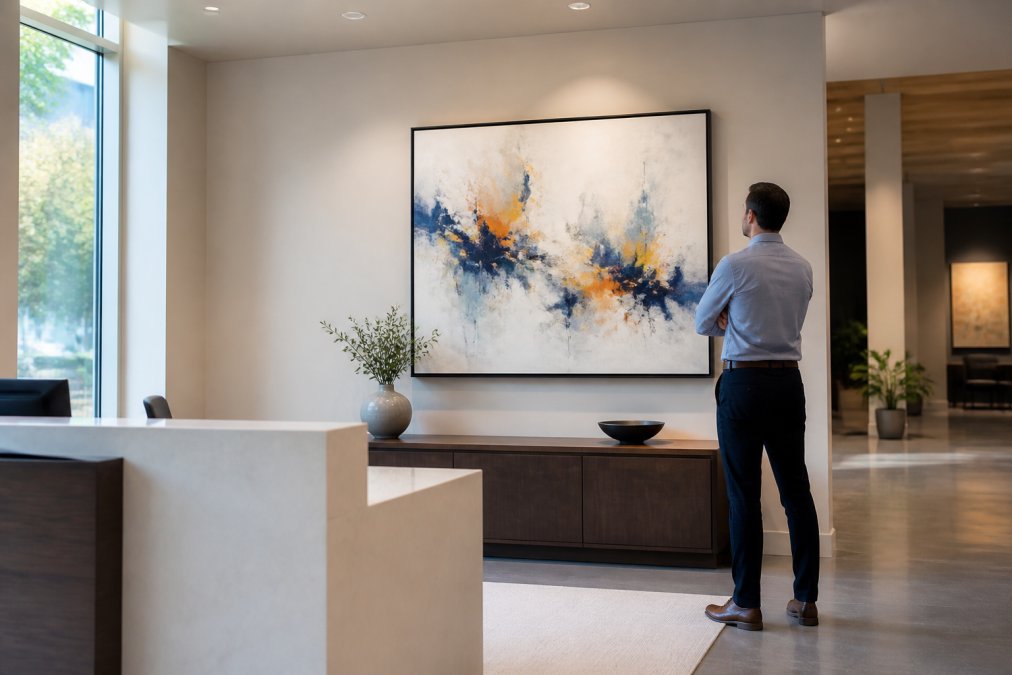
Hang art so its center sits at eye level, roughly 57 to 60 inches from the floor, and size it to about two-thirds the width of the furniture beneath it. Those two rules solve most placement problems.
The 2/3 Rule and Hanging Height on Commercial Walls
The 2/3 rule: art should span roughly two-thirds the width of the sofa, console, or credenza below it. A 60-inch console wants art around 40 inches wide. Too small and the piece looks lost; too large and the furniture looks like it's holding the wall up.
A few placement rules worth following:
- Put the largest, strongest piece on the wall visitors face when they enter. That is your focal point.
- Keep art out of direct sunlight. UV exposure fades pigments over time, even on archival materials.
- Leave at least 8 to 10 inches between the bottom of the frame and the top of the furniture.
- On a long hallway, hang pieces at consistent centers so the eye reads a single line.
How Much to Budget for Original Office Art
Budget for original office art like any capital purchase: start with the rooms clients actually see, then work backward to a number. Most guides stop at "set a budget." The useful version is a framework for what drives cost up or down before you fall in love with a piece you can't justify.
What Actually Drives the Price of an Original
Four variables move the number more than anything else:
- Artist reputation and exhibition history. An emerging artist with a regional show record prices far below an established name with museum representation. The work can be equally good; the market signal differs.
- Size and surface. A 48-by-60-inch canvas uses more material, studio time, and shipping than a 24-by-30-inch piece. Price scales roughly with square footage, not linearly.
- Medium. Oil and acrylic on canvas sit at the top of the range for most independent artists. Works on paper, mixed media, and sculpture price differently and often ship more cheaply.
- Framing and installation. A gallery-wrapped canvas needs no frame. A work on paper needs archival matting, UV-filtering glass, and a frame, adding several hundred dollars per piece.
At Just Art by John, original paintings currently range from $995 to $1,095, putting a one-of-a-kind work within reach for most small businesses. That's the entry point for a single statement piece, not a full fit-out.
A Per-Wall Framework You Can Actually Use
Instead of one lump sum, assign a tier to each wall based on who sees it and how long they linger:
- Tier 1, Reception and the owner's office. Highest spend. One strong original per wall. These are the rooms where a client forms a judgment before anyone speaks.
- Tier 2, Boardroom and primary meeting rooms. Mid spend. Either a smaller original or a large framed Giclée on archival paper, hung consistently so the rooms feel related.
- Tier 3, Hallways, break rooms, back offices. Lowest spend. Smaller prints or photography, bought as a set rather than one at a time so the corridor reads as a single line.
The Tax Angle Most Guides Skip
Where you buy affects the paperwork, and this is the part almost no competing guide covers. Many businesses treat art purchased to furnish a commercial space as an ordinary and necessary business expense under IRS guidance on business expenses. Art bought purely as an investment, held for appreciation, is generally treated as a capital asset instead, which means different rules for deduction and depreciation.
Sourcing, Provenance, and Rotating Your Collection
Buy from a source that can tell you who made the work, when, and on what. That chain of information is provenance, and it separates an acquisition from a purchase. Most guides push you toward a marketplace and stop there. The stronger play: know which sourcing path fits which wall, how to vet an artist before you commit, and how to keep the collection alive after it's hung.
Local Artists and Galleries vs. Online Marketplaces
Sourcing splits into two paths, and neither is wrong. The question is how much certainty you need before you commit.
How to Vet an Artist Before You Buy
A short checklist saves a long regret:
- Ask for the exhibition record. Where has the work been shown? A regional show history is a reasonable signal for an emerging artist.
- Ask what the work is made of. Oil, acrylic, watercolor, mixed media, and digital all age differently and need different care.
- Ask for detail photographs. Close-ups of the surface and the signature tell you more than a wide shot.
- Ask about the edition, if any. An original is one of a kind. A limited-edition print should state the edition size and be signed and numbered.
- Ask for a certificate of authenticity or a signed invoice. This is the document that supports provenance and, later, resale or insurance.
For buyers who want to understand how professional curation is organized, the American Alliance of Museums maintains directories of accredited institutions and their collections. It is a useful reference point, not a shopping list.
A Rotation Schedule That Keeps the Office Fresh
Rotation is the part almost nobody plans for, and it's the cheapest way to keep an office feeling current. A collection that shifts twice a year reads as intentional and gives long-tenured staff something new without a new budget.
A simple schedule:
- Spring rotation. Move the anchor piece from reception into the boardroom. Bring a stored work back onto a hallway wall. Rehang the reception wall around the new anchor.
- Fall rotation. Swap two meeting-room pieces. Rotate a smaller work from a back office into a Tier 2 room to test how it reads at a larger scale.
- Annual review. Photograph every wall, note what works and what does not, and decide whether next year's budget goes to one new original or several supporting prints.
Frequently Asked Questions
How much should I budget for original office art?
Most offices work with a per-piece budget rather than a single room number. At Just Art by John, original paintings range from $995 to $1,095, which sits in the accessible entry tier for one-of-a-kind work. A practical approach is to set aside 1 to 3 percent of your office refresh budget for art, then buy one strong original piece for your highest-traffic wall instead of several cheaper prints spread thin across the space.
Does original art increase office productivity?
Research on workplace environments consistently links visual stimulation and reduced visual clutter to better mood and focus, though no study isolates original art as the single cause. What matters in practice is that the work is intentional. A curated collection with a clear focal point reads as calm and professional, while mismatched prints create visual noise. Buy pieces you can live with daily, and place them where employees and clients actually pause.
What is the 2/3 rule for wall art?
The 2/3 rule says art should span roughly two-thirds the width of the furniture below it, such as a sofa, console, or credenza. On a 180-centimeter console, look for a piece or grouping around 120 centimeters wide. This ratio keeps the art visually anchored instead of floating or overwhelming the wall. For office spaces, apply the same math to reception desks and conference room credenzas.
How do I choose art that matches my office furniture?
Pull one or two colors from your furniture or flooring and look for artwork that repeats them without matching exactly. A warm walnut desk pairs well with ochre or rust tones; gray laminate opens the door to cooler blues and greens. Keep frames consistent across a room for aesthetic cohesion. If you are unsure, an original painting such as Sunday, with its gentle, reflective palette, works against most neutral office schemes.