


Table of Contents
- What Makes an Original Painting Valuable
- Artist Reputation and Career Trajectory
- How to Determine the Value of a Painting
-
How to Tell If a Painting Is Original
- Step 1: Examine the surface under raking light
- Step 2: Check the signature in context
- Step 3: Inspect the substrate and the back of the work
- Step 4: Weigh and handle the work
- Step 5: Read the documentation critically
- Step 6: Confirm title and rights
- Step 7: Use an expert when the stakes are high
- The practical takeaway
- Painting Provenance and Value
- Original Painting vs Print Value
- Condition, Conservation, and Market Demand
- Frequently Asked Questions
Last Updated: October 18, 2026
What Makes an Original Painting Valuable
An original painting valuable is determined by far more than the artist's name or subject matter. At Just Art by John, understanding these factors transforms how you approach collecting, whether you're acquiring your first piece or expanding an established collection.

Value reflects a complex interplay between artist reputation, historical significance, condition, and market demand. Some collectors focus on investment potential, others on emotional resonance. Both are valid but require different evaluation frameworks.
Valuation is a multidimensional assessment, not a single formula. An established artist with strong exhibition history typically commands higher prices than an emerging one, though emerging artists can appreciate dramatically.
Artist Reputation and Career Trajectory
The artist's standing fundamentally influences an original painting's value. Professional recognition, exhibition history, and career trajectory signal whether work is likely to appreciate or decline.
Artists represented by galleries, featured in museum collections, or recognized through major awards command higher prices because their work has been vetted through institutional channels, reducing perceived risk.
Career trajectory matters as much as current status.
Look for museum acquisitions, gallery representation, critical reviews, teaching positions, or awards, market signals that other institutions have validated the artist's significance. When evaluating an original painting valuable to your collection, research the artist's exhibition record and institutional presence.
How to Determine the Value of a Painting
Valuing an original painting is a sequence of checks that produces a range, not a precise number. Appraisers combine comparable sales, condition assessment, provenance verification, and market analysis into a defensible estimate.
Step 1: Define which value you are measuring
Appraisers use three standard definitions that can produce very different numbers for the same painting:
- Fair market value is the price a willing buyer would pay a willing seller, neither under compulsion, both reasonably informed. This is the figure used for most insurance scheduling and charitable donation substantiation.
- Replacement value is what it would cost to acquire a comparable work today, often higher than fair market value because it includes retail markup and the difficulty of finding an equivalent piece.
- Liquidation or forced-sale value is what the work would bring under time pressure, typically well below fair market value.
If someone quotes you a single number without telling you which definition they used, ask. A $5,000 insurance replacement value and a $2,500 fair market value can describe the same painting.
Step 2: Pull comparable sales, not asking prices
The most reliable anchor is what similar works by the same artist have actually sold for. Look for sales within the past two to three years matching on size, medium, subject matter, and condition.
- Auction records are the most transparent data because hammer prices are published, though you must add the buyer's premium to understand the true transaction price. A work that hammers at $1,000 with a 25% buyer's premium represents a $1,250 outlay.
- Gallery prices are asking prices, not proof of value. A gallery can list a painting at $3,000 and sell it privately at $2,200. Treat gallery tags as a ceiling to test, not a floor to trust.
- Private sales are usually undocumented and should be weighted lightly unless you can verify them through the parties involved.
A practical baseline: if an artist's 24x24 oils have consistently sold in the $800-$1,200 range at auction over two years, a new 24x24 work has a defensible starting range, adjusted for condition and subject.
Step 3: Adjust for condition and restoration
Condition moves value more than most buyers expect. A painting with intact paint layers and no restoration commands a premium over an identical composition needing conservation. Even expert restoration trims value because the work is no longer entirely original.
Step 4: Weigh provenance and documentation
Documented ownership history supports authenticity and condition confidence. A work acquired directly from the artist, held by a known collector, or included in an exhibition catalog carries more credibility than one with no paper trail; gaps widen the uncertainty band around any estimate.
Step 5: Apply market context
Demand for specific styles, subjects, and artists cycles with aesthetic trends and economic conditions. An in-favor genre may support prices above its long-run average; an out-of-favor one may trade below fundamentals.
Step 6: Get a qualified appraisal when the stakes justify it
For insurance scheduling, estate planning, charitable donation, or a purchase above a few thousand dollars, a written appraisal from a qualified professional is worth the cost. Look for credentials from a recognized appraisal organization and experience with the specific artist or genre.
Appraisal standards and credential information
What this means in practice
No method produces a single correct price. The goal is a defensible range built from real sales, honest condition assessment, and documented history. When a seller quotes a number, ask which comparables support it and which value definition it reflects.
How to Tell If a Painting Is Original
Most guides describe what an original painting looks like; fewer explain how to verify originality before money changes hands. Work through this checklist in order.
Step 1: Examine the surface under raking light
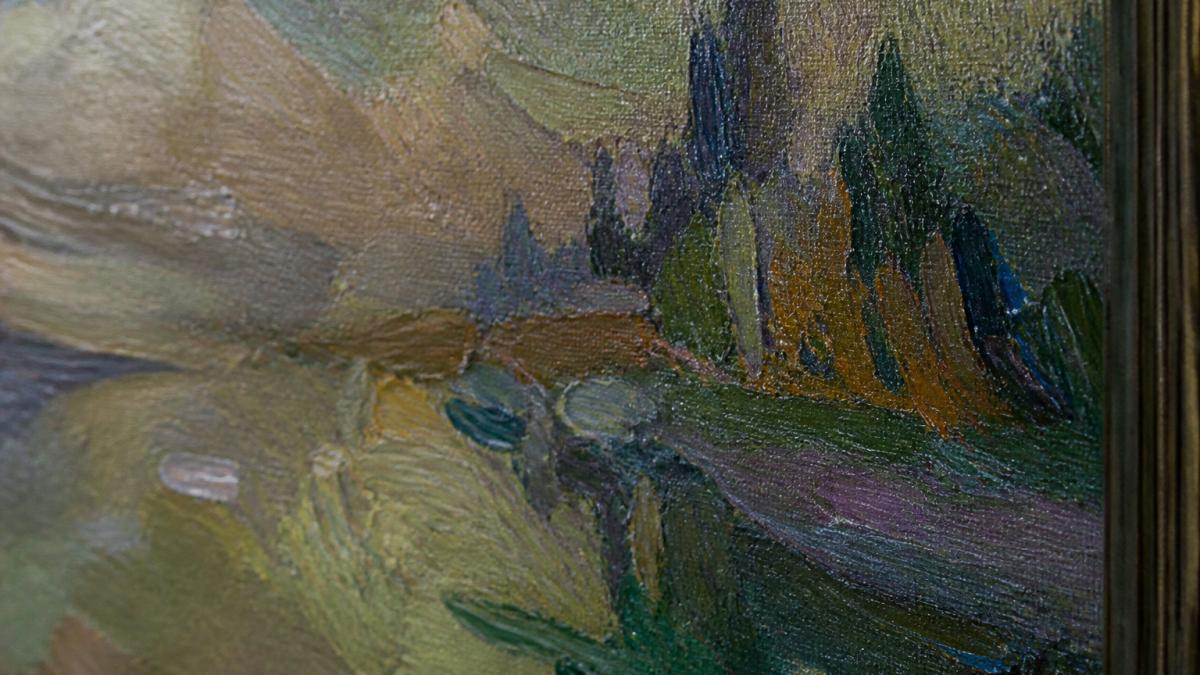
Tilt the painting so light crosses the surface at a low angle. Originals show dimensional brushwork, ridges of impasto, and paint thickness variations following the artist's hand. Prints, including high-quality giclée reproductions, present a uniform surface; under magnification they often reveal a dot pattern or halftone texture.
Step 2: Check the signature in context
On an original, the signature is usually applied in the same medium and sits within the paint layers. A printed signature looks flat and lacks dimensional quality. Under magnification, a hand-applied signature often shows brush or tool marks a reproduction cannot replicate.
Step 3: Inspect the substrate and the back of the work
Original paintings are made on canvas, wood panel, or other prepared substrates that age in specific ways. Look for age-appropriate wear, stretcher marks, staple patterns, and dust consistent with the claimed date. A canvas that looks decades old on the front but brand new on the back is a warning sign.
Step 4: Weigh and handle the work
An original painting has substantial weight from paint layers, canvas, and framing. Prints feel noticeably lighter and more insubstantial. This tactile difference is obvious in person and is one reason remote purchases carry more risk.
Step 5: Read the documentation critically
Documentation supports originality but does not replace physical examination. A certificate of authenticity is a statement by whoever issued it, and its weight depends on the issuer's credibility. A certificate from the artist or a reputable gallery carries real signal; one from an unknown dealer carries little.
Step 6: Confirm title and rights
Originality and ownership are separate questions. Ask whether the seller can convey clear title, free of liens or competing claims. Clarify what rights transfer: buying a painting does not transfer copyright unless the agreement says so, and reproduction rights can carry independent value.
Original Painting – Sunday Morning →
Step 7: Use an expert when the stakes are high
For a purchase above a few thousand dollars, or any work attributed to a known artist, an independent examination by a qualified conservator or appraiser is the most reliable verification available. They can examine materials, identify later overpainting or restoration, and assess whether the physical evidence is consistent with the claimed origin.
The practical takeaway
Originality is established by physical evidence first and documentation second. The strongest position is a work whose surface, substrate, and signature are consistent with credible paperwork. Reputable galleries provide clear documentation about whether a piece is an original work or a fine art reproduction, and that clarity is itself a signal of how the seller operates.
Painting Provenance and Value
Provenance, the documented ownership history of an artwork, significantly influences value and authenticity confidence.
Strong provenance establishes that the work is genuine and properly cared for.
Gaps raise questions. A painting that appears suddenly with no documented history before 2010, for example, creates uncertainty about its origins and condition, potentially reducing valuation.
Provenance documentation includes bills of sale, gallery records, exhibition catalogs, insurance documentation, and correspondence. Original paintings valuable for investment should come with comprehensive provenance.
Customs documentation also factors in. Paintings that crossed borders typically have documentation supporting legitimate export and import, protecting collectors from legal complications regarding cultural property or stolen art.
Original Painting vs Print Value
Understanding the difference between original paintings and fine art prints clarifies why originals command different valuations and serve different collecting purposes.
An original painting valuable as an investment asset is a one-of-a-kind work created by the artist's hand. Each original is unique, with individual variations in brushwork, color application, and composition.
Fine art prints, including Giclèé reproductions, are created from an original artwork and reproduced in multiple copies.
The value proposition differs fundamentally. An original painting appreciates as the artist's career develops and collector demand increases.
Collectors new to art often begin with prints, building confidence and developing aesthetic preferences before investing in originals. This approach makes sense financially and allows exploration without substantial commitment.
The choice between original and print depends on your collecting goals, budget, and space requirements. An original painting like Sunday Morning at $1,095 represents a significant investment in a one-of-a-kind work that may appreciate over time.
Condition, Conservation, and Market Demand
A painting's physical condition directly impacts both its monetary value and its suitability for display.
Excellent condition, meaning original paint layers intact, no significant damage, and minimal restoration, commands premium pricing.
Damage assessment includes evaluating cracks, flaking paint, water damage, foxing (brown spots on canvas), fading, and previous restoration work. Each issue reduces value proportionally to repair costs and visibility.
Professional conservation can restore damaged paintings but typically reduces value slightly because the work is no longer entirely original.
Market demand for specific styles, subjects, and artists fluctuates based on broader aesthetic trends and economic conditions.
Display conditions affect long-term preservation. Paintings exposed to direct sunlight, extreme temperature fluctuations, or high humidity deteriorate faster than those in stable environments.
Understanding what makes an original painting valuable transforms how you approach art collecting and helps you make informed acquisition decisions. Explore [pieces like Dark Flowers on a Wall](https://www.justartbyjohn.com/products/dark-flowers-on-a-wall) ($995) or Red Flowers in a Meadow ($995) to experience how original paintings transform your space while building a collection with genuine investment potential.


Frequently Asked Questions
What factors determine the value of an original painting?
An original painting's value depends on artist reputation and career trajectory, authenticity and attribution, provenance and ownership history, condition and conservation status, materials and craftsmanship quality, historical or cultural significance, and collector demand. Exhibition history and professional recognition also play a role. Each factor contributes differently depending on the artwork's age, style, and market context. Established artists with strong exhibition records typically command higher prices than emerging artists.
How do I know if a painting is original versus a print?
Original paintings show visible brush strokes, texture variation, and paint buildup when viewed closely. Prints, including fine art Giclèe prints, have uniform surface texture and no dimensional paint layers. Original paintings are one-of-a-kind works signed by the artist, while prints are reproductions, even high-quality Giclèe prints, made from an original artwork. Examining the back of the canvas, checking for artist signatures, and reviewing documentation helps confirm authenticity. Originals typically cost significantly more than prints because they represent the artist's direct creative work.
Does provenance really affect a painting's value?
Yes, provenance significantly impacts value. A documented ownership history from reputable sources, galleries, collectors, auction houses, builds confidence in authenticity and legitimacy. Paintings with clear provenance command higher prices because buyers trust their authenticity and condition history. Missing or unclear provenance creates uncertainty and typically lowers value. Documentation such as certificates of authenticity, exhibition records, and previous sales records all strengthen provenance and justify higher valuations.
How can I get an original painting appraised?
Contact a certified art appraiser or valuation expert who specializes in your painting's style or period. Professional appraisers examine the artwork in person, research comparable sales, verify provenance, and assess condition. Many galleries and auction houses offer appraisal services. For insurance purposes, use a certified appraiser recognized by professional organizations. This formal assessment provides documentation needed for insurance claims, sales, or estate planning.