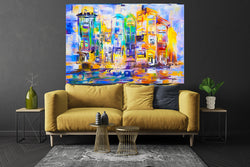


A living room can have beautiful furniture, thoughtful lighting, and a well-chosen rug, yet still feel unfinished. Often, the missing element is not another decorative object. It is art with enough presence to gather the room around it. Learning how to choose art for living room walls is less about following a rigid design rule and more about noticing what you want to feel when you walk in: energized, restored, curious, grounded, or quietly at home.
The best piece does more than fill an empty wall. It gives the room a point of view. It can echo the colors already there, introduce a welcome contrast, or bring the changing beauty of the natural world indoors. Begin with that feeling, then let scale, color, texture, and placement guide the decision.
Start With the Room's Feeling, Not Its Empty Wall
Before measuring a wall or matching a shade, spend a few minutes looking at the room as a whole. Is it a place for slow mornings and reading? A lively gathering space? A clean-lined room that needs warmth? Art is often the most expressive element in a living room, so it should support the mood rather than merely coordinate with the sofa.
A landscape, botanical image, or wildlife photograph can create a sense of stillness and connection to nature. An abstract painting with vivid movement may bring energy to a neutral interior. Sculptural canvas work adds shadow and physical depth, which can be especially welcome in rooms with simple architecture and smooth surfaces.
You do not need formal art knowledge to make a meaningful choice. Pay attention to the work that holds your gaze for an extra moment. The color, gesture, subject, or texture that keeps drawing you back is usually more valuable than choosing something because it fits a passing trend.
Choose the Right Size Before Choosing the Frame
Scale is where many otherwise good art decisions go wrong. A small piece placed alone above a wide sofa can feel tentative, while oversized art in a compact room may make the furniture seem crowded. The goal is not to make art match every dimension exactly. It is to give the piece enough visual weight to belong.
For art above a sofa, a useful starting point is a work, or grouping of works, that spans roughly two-thirds to three-quarters of the sofa's width. A 90-inch sofa, for example, often looks balanced with art that is about 60 to 68 inches wide. This can be one large statement piece, a diptych, or a carefully spaced arrangement of smaller works.
Leave breathing room around the artwork. Hanging a piece too close to the ceiling makes it appear disconnected from the seating area. In most rooms, the center of the art should sit around 57 to 60 inches from the floor, though lower ceilings, tall furnishings, and a seated viewing position can shift that slightly. Above a sofa, leave about 6 to 10 inches between the top of the sofa and the bottom of the frame or canvas.
If you are uncertain, use painter's tape to outline the artwork's dimensions on the wall. Live with the shape for a day or two. It is a simple way to see whether the piece will feel generous and grounded or too small for the space.
One Large Work or a Gallery Wall?
A single substantial artwork creates calm and clarity. It works beautifully over a sofa, fireplace mantel, or console where the room needs one memorable focal point. Original textured paintings are particularly compelling at this scale because their surface changes gently as daylight and lamplight move across the room.
A gallery wall feels more collected and personal. It can combine prints, photographs, small originals, and family pieces, especially in a living room with an eclectic or well-traveled character. The trade-off is that it requires more planning. Keep one visual thread running through the arrangement, whether that is a shared palette, similar frame finishes, or a recurring subject such as florals, landscapes, or birds.
Let Color Lead, But Do Not Over-Match
Art does not need to repeat every color in the room. In fact, a painting that matches the pillows too perfectly can disappear into the décor. Instead, look for a relationship between the artwork and the room.
You might choose a piece that picks up one quiet color already present in the space, such as the soft green in a plant, the warm clay tone in a rug, or the blue-gray of an upholstered chair. Then let the artwork introduce a few new notes. A vibrant orchid print can bring life to a room built around natural linen and wood. A deep blue abstract can lend structure to a pale, airy room without making it feel cold.
Consider the light as well. North-facing rooms often benefit from art with warmth: amber, coral, rich green, gold, or saturated color. Bright, sun-filled rooms can carry cooler blues, luminous whites, and more delicate tonal shifts. If your living room changes dramatically from morning to evening, choose work you will enjoy in both kinds of light. Texture can be especially rewarding here, since raised surfaces create subtle dimension long after the sun has gone down.
Think About Material as Part of the Artwork
The image matters, but so does the way it occupies the wall. Canvas has a soft, painterly presence and works naturally in comfortable, layered interiors. Fine-art paper behind glass can feel crisp, intimate, and classic. Metal prints offer clean edges and a luminous finish that suits modern rooms or spaces with abundant natural light.
Original art brings its own singular character. Brushwork, texture, and sculptural elements record the artist's hand and create a different experience each time you pass by. Fine-art giclée reproductions make it possible to bring a favorite image home at a more approachable price point while retaining rich color and detail.
There is no hierarchy that says every living room must begin with an original. A thoughtfully chosen print can be the piece that transforms a room. If you are deciding between formats, consider both your budget and the role the art needs to play. Invest in an original when you want one work to anchor the room for years. Choose a limited edition or premium print when you are building a collection, furnishing multiple walls, or trying a new visual direction.
Use Texture to Warm Up a Finished-Looking Room
Some living rooms are beautifully organized but still feel a little flat. This is common in spaces with neutral upholstery, painted walls, sleek tables, and minimal accessories. The answer is not always more color. Sometimes it is texture.
A textured acrylic work can bring movement to a restrained palette through layered paint, raised forms, and shifting shadows. It gives the eye somewhere to rest and discover. In a room with plenty of fabric and wood, a polished photographic print or a sleek metal presentation may provide the contrast that keeps the room from feeling too soft.
When choosing art for a living room with a fireplace, take the mantel material into account. Stone, brick, and wood already have visual texture. Art above them often benefits from a clear composition and enough color contrast to remain visible. A highly detailed piece can work, but give it room rather than surrounding it with too many mantel objects.
Make the Art Personal Enough to Keep
A living room is not a showroom. The most enduring choices often have a personal connection: a flower that reminds you of a garden, a coastal horizon that recalls a favorite trip, a bird or animal whose presence feels familiar, or an abstract composition that simply changes your mood.
Try not to buy art solely for the version of the room you think you should have. Choose for the way you live now. If children, pets, guests, and long evenings are part of the picture, a strong, expressive work may serve the room better than something overly precious or timid. If the space is a retreat, let the art offer a moment of stillness without asking for attention at every glance.
A helpful test is to imagine the work moving with you. Would you want to find a place for it in a future home? If the answer is yes, it is likely speaking to something deeper than a color scheme.
Give the Piece a Proper Place
Once the art arrives, resist the urge to hang it in the first available spot. Set it on the floor or lean it against the wall for a short time, if practical, and view it from the sofa, the doorway, and the adjoining room. Notice its sightlines. A piece seen from the entry can create a beautiful first impression, while art opposite a window may need careful placement to avoid glass glare.
Keep nearby accessories simple. Art needs visual space to do its work. A lamp, a plant, or a few books can support the composition, but too many competing objects can weaken even a remarkable painting.
The right artwork does not have to explain itself. It simply begins to feel as though the room was waiting for it: color settling into place, a wall gaining depth, and an ordinary evening made a little more beautiful.