

Table of Contents
- Why Original Sculptures Beat Mass-Produced Decor
- How to Match Art With Wall Color Before You Buy
- Sculpture Placement Tips for Living Rooms
- How to Display Small Sculptures on Shelves
- Materials, Scale, and Price: What Original Sculptures Actually Cost
- Authenticity and Provenance: Verifying You're Buying the Real Thing
- Care and Maintenance for Indoor Sculptures
- Frequently Asked Questions
Last Updated: September 16, 2026
Why Original Sculptures Beat Mass-Produced Decor
Walk through any home goods store and you will see the same resin figures and gold-painted deer stacked on clearance shelves. That sameness is why buying original sculptures for home decor has moved from a niche collector habit into a mainstream design decision. An original piece carries the artist's hand, a specific material composition, and a presence no factory mold can replicate.
How to Match Art With Wall Color Before You Buy
Matching art to wall color starts with undertones, not the dominant shade. A wall painted "warm white" can read yellow, pink, or cream depending on its base, and a sculpture that clashes with that undertone will never sit right.
Reading Undertones in Bronze, Marble, and Mixed Media
Bronze has a natural warmth that leans amber or brown, so it pairs cleanly with cool grays, deep blues, and true whites. Marble is cooler and often carries gray or blue veining, making it a strong contrast against warm beige or terracotta walls. For mixed-media pieces, pull your color cue from the largest single material and let the rest act as accent.
Sculpture Placement Tips for Living Rooms
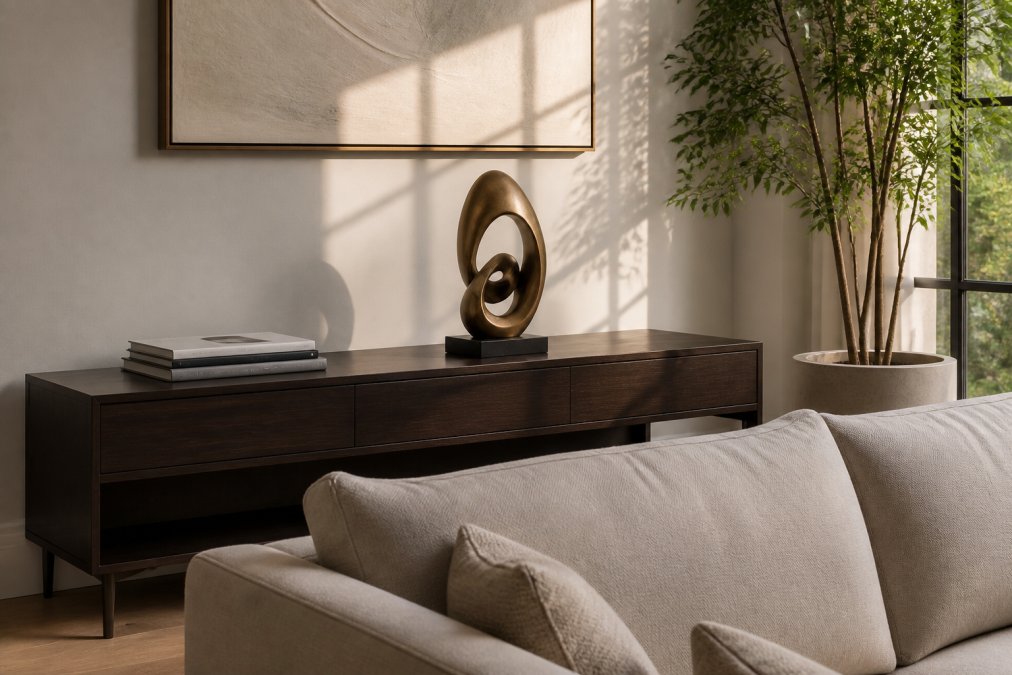
The best placement for a living room sculpture is at eye level on a surface that lets the piece breathe, typically a console, side table, or open shelf with a few inches of clearance on every side. Crowding is the most common mistake.
How to Display Small Sculptures on Shelves
Displaying small sculptures well comes down to grouping and negative space. Three to five pieces of varying heights reads as a curated collection; ten pieces of similar size reads as clutter.
- Vary height deliberately: tall, medium, short, then repeat the rhythm
- Leave roughly a third of the shelf empty so each piece has room
- Group by material or palette, not by size alone, so the shelf feels intentional
- Add one book stack or a single framed print to anchor the arrangement
- Keep the most detailed piece at eye level where it can be studied
Materials, Scale, and Price: What Original Sculptures Actually Cost
Original sculpture pricing tracks four variables: material, scale, technique, and the artist's reputation. Understanding how each moves the number is the difference between paying a fair price and overpaying for a mold-made piece with an artist's name attached.
Material Trade-Offs Buyers Should Know
Each material carries a distinct cost profile and trade-offs:
- Bronze (solid cast): The most labor-intensive route. Lost-wax casting involves a mold, a wax positive, a ceramic shell, a kiln burnout, and a pour, then chasing, patina, and mounting. Expect the highest per-pound cost and the heaviest weight.
- Carved stone (marble, alabaster, soapstone): Raw stock is heavy, shipping is expensive, and carving is slow. Marble is the prestige option; alabaster and soapstone are softer, cheaper, and more prone to chipping.
- Cast or bonded marble: Stone dust mixed with resin and poured into a mold. It looks like marble from across a room but weighs far less and costs a fraction of carved stone. It is legitimate, it just should not be priced as carved stone.
- Steel and fabricated metal: Welding, grinding, and finishing are skilled labor, but the raw material is inexpensive. Large fabricated pieces can cost less than a small bronze.
- Wood: Cost swings widely by species. A hand-carved walnut or mahogany piece sits near bronze territory; softwood or reclaimed wood sits far lower.
- Resin and mixed media: The most accessible entry point. Resin casts from a mold quickly and cheaply, which is why it dominates mass-market decor. An original resin piece is still original if the artist sculpted the master and finished each cast by hand.
How Scale Changes the Math
Scale does not scale linearly. Doubling the height of a bronze can multiply the cost by four or more, because the mold, metal volume, kiln capacity, and shipping weight all grow faster than the dimensions. A tabletop piece under 12 inches is the most affordable category; 12 to 30 inches is the sweet spot for most homes. Floor-standing work above 36 inches is where shipping, crating, and installation start to rival the sculpture itself.
What Actually Drives the Price Up or Down
| Factor | Pushes Price Up | Pulls Price Down |
|---|---|---|
| Material | Solid bronze, carved stone | Resin, bonded marble, small mixed media |
| Scale | Floor-standing, large format | Tabletop, under 12 inches |
| Technique | Hand-cast, hand-finished, unique patina | Cast from a mold, uniform finish |
| Edition | One-of-a-kind, no edition | Open edition or numbered run |
| Provenance | Signed, documented, exhibition history | Unattributed, no paperwork |
| Artist | Established reputation, gallery representation | Emerging or self-taught |
A useful rule of thumb: if the price feels low for the material and scale described, ask what the piece is actually made of. A "bronze" sculpture priced like a resin one is almost always resin with a bronze finish.
A Realistic Budget Framework
Most buyers fall into one of three bands. Under a few hundred dollars buys an original small resin, wood, or mixed-media piece, or a bonded-marble tabletop work. The mid hundreds to low thousands buys a genuine small bronze, carved stone, or larger handcrafted work. Above that, you are paying for scale, material rarity, and the artist's reputation as much as for the object.
Authenticity and Provenance: Verifying You're Buying the Real Thing
Authenticity verification means confirming three things: who made the piece, when, and whether the documentation matches the object. A legitimate seller should answer all three without hesitation. The difference between an original and a well-made reproduction is the difference between an asset and a decoration.
What Counts as an Original
"Original" is not a single category but a spectrum, and knowing where a piece sits tells you what you are buying:
- Unique piece: The artist made one, and only one. The strongest form of originality.
- Limited edition: The artist authorized a fixed number of casts or prints, each numbered and usually signed. A bronze edition of 8 is still original work; an open edition of 500 is closer to reproduction.
- Artist's proof: A cast pulled outside the numbered edition, typically for the artist's own records. Still original, often more valuable.
- Reproduction or replica: A copy made by someone other than the original artist, or a mold pulled from an existing work without the artist's involvement. Not original, regardless of quality.
The Documentation to Ask For
A serious seller should be able to provide, on request:
- A signed certificate of authenticity naming the artist, the title, the year, the material, and the edition size if applicable.
- The artist's signature or mark on the piece itself, usually on the base, the underside, or a hidden edge. Compare the mark to known examples of the artist's signature.
- Provenance records: gallery receipts, exhibition catalogs, prior auction listings, or a documented chain of ownership.
- For editions, the edition number (for example, 3/8) stamped or written on the piece, matching the certificate.
How to Spot a Reproduction
A few patterns recur:
- Seams and mold lines. A cast piece will have a seam where the mold halves met. On a hand-finished original, the artist grinds and chases that seam away. A visible, uniform seam running the length of the piece is a sign of an unfinished mold cast.
- Uniform texture. Hand-finished surfaces vary. If every curve has the same smoothness and the same patina depth, the piece likely came out of a mold and was not individually worked.
- Weight that does not match the material. Solid bronze is heavy. If a "bronze" piece lifts easily, it is hollow or resin.
- A signature that looks printed or stamped rather than incised. Hand-signed marks have slight variation. A perfectly uniform signature is often a mold feature.
- No edition number on a piece described as limited. If the seller says "limited edition" but cannot tell you the number or the total, ask why.
Why Provenance Matters Beyond Trust
Originality is the core of art investment. A reproduction, however well made, does not appreciate the way a documented original can. Provenance lets a future buyer, insurer, or appraiser confirm what you own: without it, you have an object; with it, a record.
Care and Maintenance for Indoor Sculptures
Indoor sculpture care is mostly about controlling light, dust, and moisture. Direct sunlight fades patina and painted surfaces, so keep pieces out of sustained sun. Dust with a soft, dry brush rather than a cloth, which can catch on textured surfaces and edges.
- Bronze: dust dry, avoid abrasive polishes that strip patina
- Marble: use a damp cloth only, never acidic cleaners
- Painted or mixed media: dry dust only, keep away from humid rooms
- All materials: keep stable temperature and humidity to prevent cracking
Frequently Asked Questions
How do I choose the right original sculpture for my home?
Start with the room, not the sculpture. Measure the surface or floor area you have, note the wall color and lighting, then decide whether you want a tabletop piece or a floor-standing statue. A 12 to 18 inch tabletop sculpture works on a console or shelf, while floor pieces need at least 24 inches of clearance. Buy what you will still enjoy looking at in five years, not what matches a trend.
Is buying an original sculpture a good investment?
Original works hold value differently than prints because each piece is one of a kind. A signed original from a working artist gives you a documented object with a known maker, which is the foundation any future resale depends on. Treat the purchase as something you will live with first. If it appreciates, that is a bonus, not the reason to buy.
What materials are best for indoor sculptures?
Bronze, marble, stone, wood, and fired clay all work well indoors. Bronze develops a patina over time and tolerates handling. Marble and stone hold cool tones that read well against warm walls. Wood and clay suit softer, more organic interiors. Match the material to the room's humidity and sunlight: keep porous stone and untreated wood out of direct afternoon sun and away from heating vents.
How do I know a sculpture is authentic and not a reproduction?
Ask for the artist's signature, a dated certificate of authenticity, and the piece's exhibition or purchase history. A legitimate seller will provide the artist's name, the year the work was made, and the materials used. Photograph the signature and any markings when the piece arrives, and keep the paperwork with your records. If a seller cannot answer basic provenance questions, walk away.